The weekend
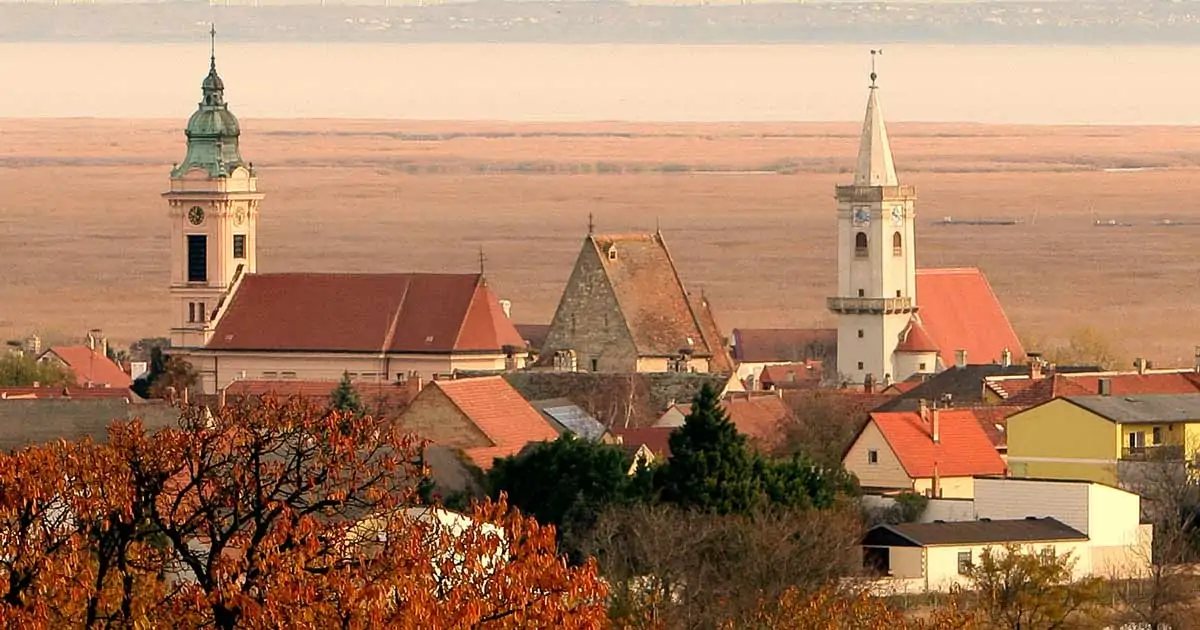
The Wachau's opposite number, and the answer for anyone who looked at those terraces and thought no. The Neusiedlersee is the westernmost steppe lake in Europe: 36 kilometres long, barely a metre deep, ringed by 180 square kilometres of reeds, warm enough to swim in and shallow enough to walk half a mile out. Around it runs the Neusiedler See Radweg, a signed circuit that is as close to perfectly flat as cycling gets.
The wine is seriously good and largely unknown in Britain. Blaufränkisch — dark, peppery, high-acid, ageing beautifully — is Austria's great red grape, and the Leithaberg slopes above the western shore are where it is at its most mineral. Rust makes Ausbruch, a botrytis sweet wine with its own legal category, and the town paid its way out of feudal control with it.
The lake delivers well beyond the wine: Seewinkel on the eastern shore is a national park of salt pans and shallow pools with flamingo-pink light at dawn and serious birdlife, and the ground you are riding over was the exact spot where the Iron Curtain first came apart in August 1989.
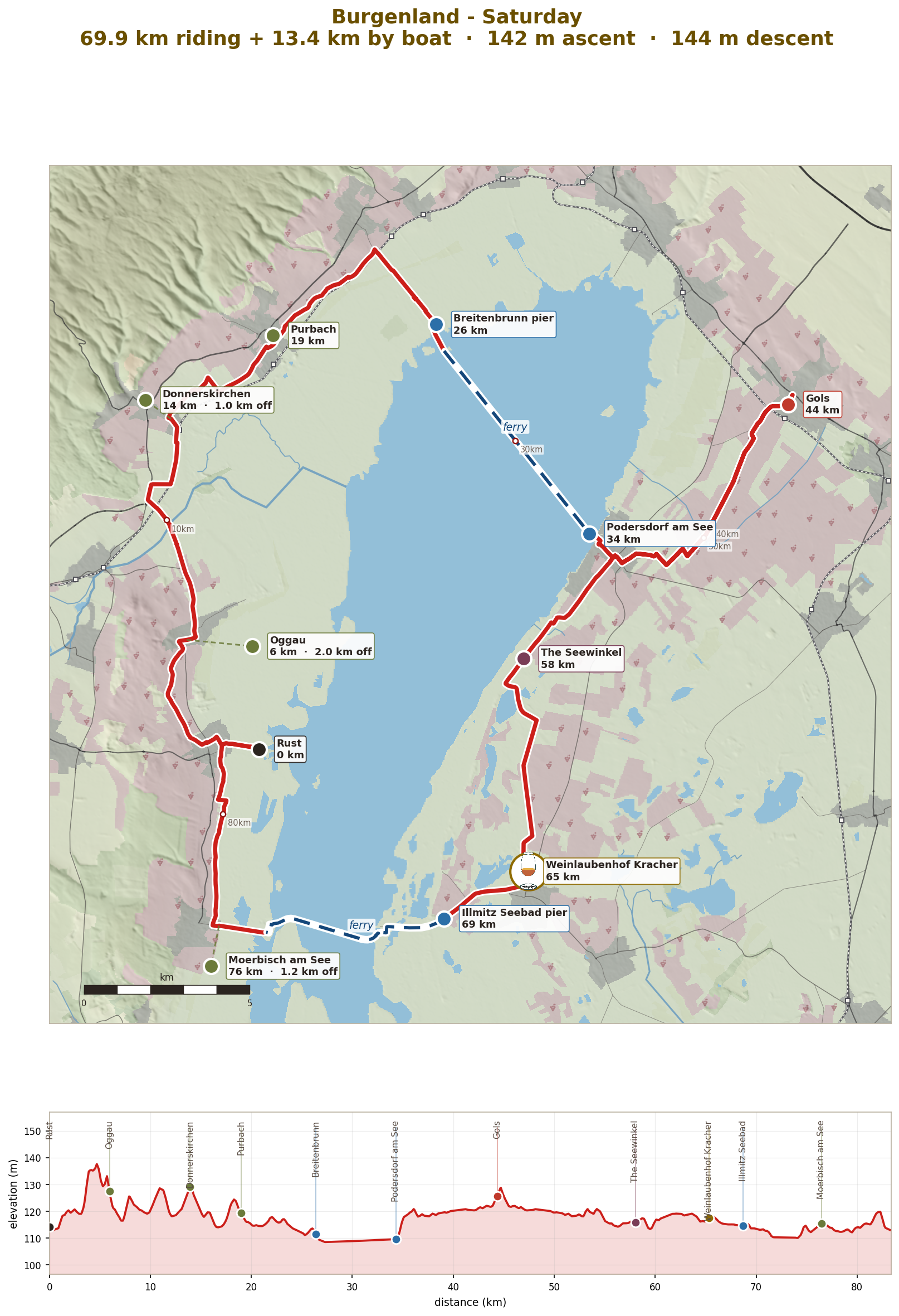
The lake is the whole point of this one, and the bike ferries across it are what make the Saturday work. Rather than shuttling out and back to one shore, the day goes all the way round: up the western shore to Breitenbrunn, across the wide part of the lake by boat to Podersdorf, north to Gols for lunch and the cellars, then south down the eastern shore to Illmitz and back over the narrows to Mörbisch. 70km of riding, 13km of it done sitting down on a boat, and 142 metres of climbing in the whole day — which is to say none.
It is also the right way round for a wine weekend. The long road section comes first, before anyone has tasted anything; the drinking happens at Gols and Illmitz in the afternoon, with a dozen flat kilometres and a boat ride between the last glass and the front door.
And the accommodation is the best on the whole list. The Seehütten in the bay at Rust are reed-thatched cabins standing on wooden platforms in the water of the lake itself, reached along a jetty — so the bikes come to the door even though the electric boat that comes with the hut cannot carry them.
The two crossings keep different seasons, and that shapes the choice of month. The southern one, Illmitz–Mörbisch, runs daily from the start of April to mid-October — every half hour in high season, hourly either side. The northern one, Breitenbrunn–Podersdorf, runs only from late April to the end of September, and at weekends within that window rather than daily except in high summer. The full circuit therefore needs a Saturday between late April and late September.
Come in October and the northern boat has gone, but the southern one has not. The circuit still works — you simply ride the top of the lake through Winden and Weiden instead of sailing across it, which turns 70km into 81km on ground just as flat. That is also the month of the two Gols festivals, Rot & Reife in the Neubaugasse and the Adrimarsch Fest, both in the same village on the same day. So October costs an hour and a dozen kilometres and buys a party — a fair swap, if the legs are willing.
A little history
Burgenland was Hungarian until 1921, which is why the cooking uses paprika and the villages have long single-street layouts. Rust bought its freedom in 1681: the town paid Emperor Leopold I sixty thousand gulden and thirty thousand litres of its own Ausbruch wine to become a royal free city, answerable to no local lord — the only town in Europe that has ever bought independence with dessert wine. The Esterházy princes ruled from Eisenstadt and employed Joseph Haydn for three decades. Then the twentieth century put an Iron Curtain across the lake: the eastern shore was watchtowers and minefields until, on 19 August 1989, a symbolic 'picnic' at the border near Sopron ended with the gate open and six hundred East Germans running through it — the first breach in the wall, three months before Berlin.
What it costs
Per person for the whole weekend, priced for a party of four — two twin rooms, or one whole place between you. Everything but the bed is fixed, so where you sleep is the only row that moves and the only one shown as a range.
| Per person | |
|---|---|
| Getting there, both ways | £160 |
| Three nights | £70–260 |
| Bikes and getting about | £52 |
| Eating, drinking and tastings | £145 |
| The weekend, per person | ~£430–620 |
Where to sleep
| Option | Per person |
|---|---|
| Hotels — two twin rooms | |
| Pensions in Rust | €34 a night £90 for three |
| Seehotel Rust — four-star on the lake, with a spa | €100 a night £260 for three |
| Airbnb and self-catering — one whole place | |
| Entry-level flats round the lake | €27 a night £70 for three |
| A Seehütte on the water — 38m² on a deck over the lake, with an electric boat and beds up a ladder under the roof. Sleeps four, let whole, and the reason to come | €58 a night £150 for three |
Rust itself is too small to have published market data; the flat figure is for Neusiedl am See, ten kilometres up the same shore.
Eating and drinking
| What | Each |
|---|---|
| A Heuriger supper | €10–20 |
| Dinner in Rust or Mörbisch | €25–40 |
| A glass of Blaufränkisch | €3–5 |
| Tastings round the Neusiedlersee | €5–15 |
The £145 above assumes the middle of this list: a cheap lunch, an ordinary dinner, one good one over the weekend, and wine throughout. It does not change with the room.
Day by day
Friday Arrive, and settle into the hut
- Mid-morning flight to Vienna; pre-booked car to Rust, about fifty minutes.
- Out along the Seestraße to the Seebad and the huts — reed-thatched cabins on wooden platforms standing in the lake, reached by a jetty, with a deck over the water and a boat tied to it.
- Collect the bikes, then walk the old town: pastel houses, arched courtyards, the fortified Fischerkirche with its medieval frescoes, and stork nests on nearly every chimney — occupied from late March to August, empty after that, since the birds leave for Africa at the end of the summer.
- Take the boat out before dinner. The electric boat comes with the hut, needs no licence, and the channel through the reeds opens onto the lake in a few minutes. The sun sets behind the town and the Leithaberg, so you get Rust's two towers in silhouette from the water — around 9pm in midsummer, closer to 6pm in October. Take a bottle; be back on the jetty before dark, because the reed channels are a maze and boating on the lake is a daylight business.
- Then a first glass of Ausbruch in a Rust Buschenschank.
Saturday All the way round the lake, half of it by boat
- 70km of riding, 13km by boat, 142m of ascent. Measured from the routed line, not estimated. It is a full day but a flat one, and the two ferries do the work that would otherwise be forty kilometres of shore road.
- Away by eight. The only morning boat from Breitenbrunn leaves at 10.00, and it is 26km up the western shore to reach it — through Oggau, Donnerskirchen under the Leithaberg, and Purbach with its Kellergasse of vaulted cellars cut into the loess. Ninety minutes at a civil pace, and it is the best red-wine ground on the lake.
- The crossing. Eight kilometres of open water to Podersdorf and its lighthouse, on the flat eastern shore. Bikes go aboard; buy tickets the day before, because the boats are small.
- Gols at 45km, ten flat kilometres north of the pier. Austria's largest wine village and the centre of its natural-wine scene: Heinrich, Preisinger and Pittnauer are within a few streets of each other. Book one of them — they are working cellars, not tasting rooms — and eat here, because there is nowhere better for the next twenty kilometres.
- South through the Seewinkel. Ten kilometres of riding between the reed belt and the salt pans: shallow Lacken, white donkeys, grey cattle and a great many birds. Flat, open and unlike anywhere else in central Europe.
- Kracher at Illmitz, 65km — the family that made Austrian sweet wine famous — and then the Seebad pier two kilometres on. The Illmitz–Mörbisch boat runs every half hour in season and takes about twenty-five minutes.
- Mörbisch to Rust is eight kilometres, flat and along the water, with the maize hung in bunches across the house fronts on the way out of the village. Back at the hut by six.
- If you are here in October, the northern boat has stopped: ride on from Breitenbrunn round the top of the lake through Winden and Weiden into Gols, 22km, and pick the day up there. The southern crossing home still runs — hourly, last boat at four — so the shape of the day survives; it is just 81km instead of 70km.
69.3 km · 143 m of ascent · 109–138 m
Sunday Into Hungary: a Roman quarry and the hole in the Iron Curtain
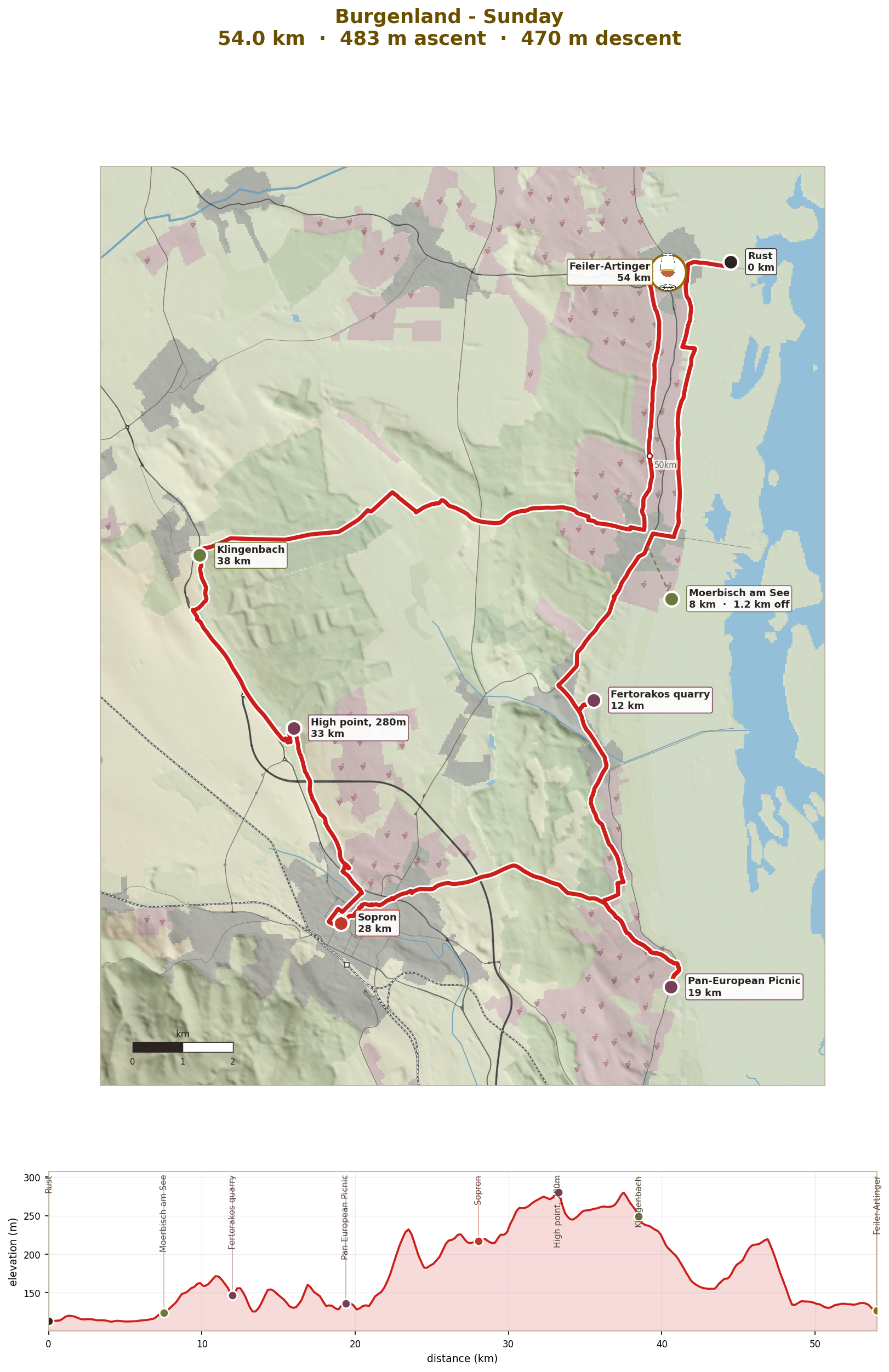
- 54km with 483m of ascent — and the surprise of the weekend, because this is the only day here that climbs. Nothing steep, but the lake is behind you from the twentieth kilometre on.
- South along the shore to Mörbisch at 8km, the prettiest of the lake villages, then over the border.
- Fertőrákos at 12km: a Roman limestone quarry cut down into vast underground halls, with pillars of rock left standing to hold the roof. It is used as a concert space now, and a Mithras shrine sits nearby, left by the legionaries who worked the stone.
- The Pan-European Picnic memorial at 19km, on the border itself at Sopronpuszta. On 19 August 1989 a symbolic border gate was opened here and around six hundred East Germans walked through into Austria — the first breach in the Iron Curtain, three months before Berlin. Open air, and on the exact ground. The route runs out to it and back, a five-kilometre spur that costs almost nothing in height.
- Then the hard part, and it comes before lunch. Out of the hollow at the memorial the road lifts 58m in a single kilometre — the steepest stretch of the whole weekend — and keeps climbing to Sopron at 28km. Arrive hungry: a medieval town inside a horseshoe of baroque streets, with a fire tower over the old gate, and open on a Sunday, which Austria is not.
- Afterwards it goes up again, gently. North out of Sopron into the hills, topping out at 280m at the 33km mark — 107m of climbing spread over ten kilometres, so a drag rather than a wall — and back into Austria at Klingenbach, 38km.
- Fifteen kilometres home, downhill then flat along the foot of the Ruster Hügelland, with one last bump at 46km before the run into Rust.
- Swim at the Rust Seebad if anyone is willing — the lake is a metre deep and holds its warmth — and then the second boat window of the weekend, an hour on the water with whatever came back from Gols in the panniers.
54.0 km · 484 m of ascent · 112–281 m
Monday Eisenstadt, then home
- The best of the three boat trips, if anyone will get up for it: a shallow steppe lake at dawn means mist lying over the reeds and the water going pink before the wind picks up. Sunrise runs from 5am in June to 7am in October.
- Half an hour to Eisenstadt for Schloss Esterházy and the Haydnsaal, the hall Haydn wrote for across thirty years as court composer, and one of the best-sounding rooms in Europe.
- Car to the airport, about fifty minutes, and the evening flight home.
When to go
Spring — March to May
10–20°C. The reed beds come alive with birds — this is one of Europe's great spring migration sites — and the lake ring is empty of cyclists. Windy, and the water is too cold to swim.
Summer — June to August
20–29°C, and the lake reaches 24–26°C. It is a metre deep, so it warms like a bath; this is windsurfing and swimming season, and the operetta plays on a floating stage at Mörbisch.
Autumn — September and October
11–20°C, the vines turning, the Seewinkel misty at dawn, and the growers relaxed once picking is done. Note that the lake ferries stop in mid-October.
When to go
Early September, when the ferries still run at weekends, the water is warm enough to swim and the harvest is starting — or high summer if swimming and daily boats matter more than the vineyards. Late May is the quiet alternative: birds in the reed beds, empty paths and the crossing already running. October still works — the southern crossing runs to the middle of the month and the two Gols festivals land in it — but you ride the top of the lake rather than sailing across it.
Festivals
None of this weekend assumes a festival. The rides work on any weekend of the season. If your dates land on Martiniloben in November or the Gols cellar openings, ride the lake circuit on the Saturday and walk the cellar lane in the evening — it is a short walk from the base and no bicycle is required. The trade is worth stating plainly: on a festival weekend the growers are behind a stand in the square rather than showing visitors round a cellar, so book private tastings weeks ahead or accept that some will be shut, and expect beds to be scarcer, dearer and gone months in advance.
Spring
Golser Weinfrühling — April
The growers of Gols open their cellars together for a spring weekend, the counterpart to the autumn events.
WeinWandern Gols and Wein mit Weitblick — May and June
Guided walks and tastings through the vineyards above the village, with the lake laid out below.
Summer
Seefestspiele Mörbisch — July and August
Operetta on a floating stage on the lake. As Austrian as it sounds, and genuinely spectacular after dark.
Autumn
Rot & Reife and the Adrimarsch Fest, Gols — October
A single cellar lane opening together to pour mature Blaufränkisch, and the old end-of-harvest thank-you to the pickers in the WeinKulturHaus courtyard.
Martiniloben — around 11 November
Cellars open across Burgenland for Saint Martin: young wine, roast goose and art in the press houses.
Getting there
From London, per person, assuming bikes are hired in Rust rather than flown. Fares checked September 2026 and converted at €1 to 86p.
| Leg | Time | Cost |
|---|---|---|
| The flight | ||
| Gatwick, Heathrow or Stansted to Vienna (VIE) — BA, easyJet, Ryanair and Austrian, several a day, from £45 out and £50 back | 2h 20 | £48 |
| Airport to Rust | ||
| Pre-booked car or transfer, €110 for the vehicle — split three or four ways this is the sensible choice, and the only one that arrives in daylight on a Friday | 50 min | £32 |
| Waiting, bags and finding the driver | 45 min | — |
| Door to door, one way | 3h 55 | £80 |
| Both ways | £160 | |
Public transport is possible and cheap — bus from the airport to Wien Hauptbahnhof, then bus to Eisenstadt and on to Rust, €8–17 all in — but it is two and a half to three hours with two or three changes and a thin Sunday service. Rust is the one base on this site where a car transfer earns its money. If you would rather not, base at Neusiedl am See instead: one bus from the airport, an hour, and the lake path starts at the door.
Bike hire
Assumes hybrids — the lake path is flat, and the wind is the only hill.
| Shop | Rate |
|---|---|
| Fahrradverleih Schneeberger, Rathausplatz 15, Rust — thirty-five years in the same square. Trekking bikes and e-bikes, May to October. Closed Wednesdays, and it takes no reservations, so go early | €12 a day €25 for three |
| Fahrradverleih Neusiedlersee, Oggauer Straße 25, Rust — e-bikes only, collected and returned round the clock, and it will book ahead | €25 a day €60 for three |
Schneeberger’s published list is a few seasons old, so treat these as the shape rather than the invoice.
Getting about
| What | Cost |
|---|---|
| Bike hire for the weekend, three days on a trekking bike | £22 |
| Illmitz–Mörbisch bike ferry, the southern crossing — €10 single, €18 return, bicycles carried free. Daily, early April to mid-October | £9 |
| Breitenbrunn–Podersdorf, the northern crossing — Holiday Lines, €16 single, bicycles free. Weekends from late April, daily late June to early September | £14 |
| Local buses round the lake, allow | £7 |
| Getting about, whole weekend | £52 |
Both crossings can be cancelled at short notice for wind or low water — the Saturday depends on them, so check on the morning.
The wineries
Ernst Triebaumer
The wine that proved Blaufränkisch could be world class: the Mariental bottling from a walled site above the town. A family operation, and a straightforward one to visit if you write ahead.
Feiler-Artinger
One of the classic Rust houses, in a Baroque courtyard just off the square, making Ausbruch alongside serious dry whites and reds.
Heidi Schröck
Small, individual and much admired: Furmint, Muscat and Ausbruch from someone who has done as much as anyone to argue for Rust as a serious wine town rather than a sweet-wine curiosity.
Kracher
Across the lake in the Seewinkel, where the mists come off the shallow water. The Trockenbeerenauslesen made Austrian sweet wine famous, and the dry wines are worth the stop too.
Gols — Heinrich, Preisinger, Pittnauer
Three of the best-known names in Austrian low-intervention wine, all in one village on the north-eastern shore. Between them they explain most of what has happened to Austrian red wine in twenty years.
The wines
Blaufränkisch above all — peppery, dark-fruited, firm with acid, and taken seriously by anyone who has met a good one. Zweigelt is the easier everyday red, St Laurent the softer cousin. Whites are Welschriesling, Grüner Veltliner and Chardonnay, and Rust still grows Furmint, the Tokaj grape, left over from the Hungarian centuries. Then the sweet wines: Ruster Ausbruch, its own DAC since 2020, and the botrytis and ice wines of Illmitz across the water, where the shallow lake generates exactly the autumn mists the mould needs.
Eat & drink
| Friday | Buschenschank in Rust — cold plates and a glass of Ausbruch |
| Saturday | Gols: whatever the Neubaugasse is cooking, alongside the mature reds |
| Sunday | Sunday lunch in Sopron, over the border and open |
| Monday | Eisenstadt before the airport run |
The food
Pannonian, which means Hungarian with Austrian portions: paprika in the pans, Fogosch (zander) from the lake, goose around Martinmas, Grammelpogatscherl — crackling scones eaten with young wine — and strudel. Eating happens in a Buschenschank, a grower's own tavern licensed to serve its own wine with cold food, marked by a bundle of twigs over the door.
Where to stay
Seehütte Neusiedlersee
Reed-thatched huts of 38m² on a wooden deck over the water in the bay of Rust, reached along a jetty. Heating, mosquito screens, a small kitchen, and an electric boat thrown in that needs no licence. Deliberately simple — closer to a sailing holiday than a hotel — and the most memorable night's sleep on this whole list. Four people maximum per hut, so a group of five needs two.
Hotel Rusterhof
The dry-land fallback: a handful of suites in a restored 16th-century house on the square, with a good restaurant underneath. Useful if the huts are shut for the season.
Mooslechners Weinhaus
A winegrower's house turned small hotel, with the family's own wines and a courtyard — and enough rooms to take a group of five without splitting it.
Practical
- Austria allows cyclists 0.8 g/l against 0.5 g/l for drivers — the most forgiving rule on this list, though not a licence to treat it as a target. Hungary, over the border on the Sunday, is zero tolerance — that day is a dry ride. See the country-by-country table.
- Three checks before you book the hut. That they open into October, that the one you take has heating fitted, and the lake level — the Neusiedlersee has run very low in recent dry years, and the channels are shallow at the best of times.
- The hut takes four at most. There are three double beds — one proper one on the ground floor and two mattresses on slatted frames up a ladder under the tent-shaped roof — so two to four people fit comfortably, with a bed to spare at three. Whoever takes the loft should be happy on a ladder and untroubled by a low ceiling. There is no margin: a fifth person means a second hut.
- The boat cannot take bikes — but it does not need to. The jetty is walkable, so the bikes live at the hut and you ride out along the Seestraße.
- The Saturday hangs on a single departure: the 10.00 from Breitenbrunn. Holiday Lines (Schifffahrt Gmeiner, +43 2683 5538) run Breitenbrunn–Podersdorf at 10.00 and 16.15, weekends from late April, daily from late June to early September, weekends again to the end of the month. Miss the ten o'clock and the day becomes the October version. Leave Rust by eight.
- The southern crossing is the reliable one. Illmitz–Mörbisch is served by Gangl (+43 2175 2158), Drescher Line (+43 2685 8820) and Schifffahrt Weiss, daily from the start of April to mid-October: every half hour from 9am to 5pm in high season, hourly 10am to 4pm at either end. Around €10 single, bikes free, crossing about twenty-five minutes. Gangl asks for a minimum of four passengers, so a pair may have to wait for company.
- A third crossing exists if you want a shorter day. Rust–Podersdorf goes straight from the Seebad by the hut, run by Holiday Lines (10.00 and 15.00 out, 11.30 and 16.30 back) and by Schifffahrt Knoll (+43 664 388 45 88) into October on Tuesdays and Fridays. Out and back to Gols that way is 45km rather than 70km — the fallback if the weather is poor or the group is not in the mood.
- Wind, not rain, is what stops the boats. The lake is a metre deep and gets rough fast; sailings are cancelled at short notice in storms or when the water is low. Check the operator's page on the morning itself, and have the October routing in your back pocket.
- In high summer the boats run daily, which makes the whole lake usable — you can cross on a whim, swim on the far shore and come back in the evening. That, plus water at 24–26°C, is the case for July and August here.
- Book a bike-carrying van for the festival Saturday, if you go in October. Rot & Reife and the Adrimarsch Fest are not compatible with the 45km round the north shore back to Rust. Several Burgenland taxi firms advertise bike carriage — Eisenstadt and Apetlon both have them — but a van for four people and four bikes is not something to arrange at nine on a Saturday night.
- Passports for Sunday. Hungary is in Schengen so there are no routine checks, but carry ID. Sopron takes cards everywhere; small places want forint.
- Sunday is the hard day, not the Saturday. 483m of ascent against 142m, and the steepest kilometre of the weekend lands just before lunch rather than after it — which is the right way round.
- Do not try to shorten it by turning back at Sopron. Retracing the outward leg is 56km with 493m of ascent: longer than the loop and no easier. The way home over Klingenbach is the gentler half of the day. If you want a genuinely short Sunday, either cut it at Fertőrákos — 24km and 108m, home by lunch — or ride to Sopron and take the GySEV train to Schützen am Gebirge, then the 9km down to Rust. The train carries four bikes, space permitting, so a party of four has no margin at all.
- Check the Fertőrákos quarry's opening hours for your month before building the day around it. It closes for the winter and the shoulder-season hours are short.
- Austria allows cyclists 0.8‰, which is more forgiving than France — but somebody still has to steer the electric boat home.
- The boat is a daylight activity. Plan the pottering for the hour before sunset or the hour after dawn — the reed channels are a maze in the dark — and remember that whoever steers is subject to Austria's 0.8‰ limit like any other skipper.
- Take a swimming costume. The lake is a metre deep and holds its warmth; even an October swim is entirely plausible.
- Buschenschanken keep their own hours, opening in rotation. The tourist office in Rust publishes which are open in any given week.
- Neusiedler See Tourismus — the lake region — routes, ferries, villages and events
- Burgenland cycling — official cycle route pages, including the lake circuit
- Bike ferries and transport — the crossings, and crucially their operating season
- Wein Burgenland — the regional wine board — producers, appellations and Martiniloben
- Free City of Rust — the town itself: the Fischerkirche, the storks and the growers
- Gols events calendar — where Rot & Reife and the Adrimarsch Fest are listed
- Seehütte Neusiedlersee — the huts in the bay at Rust, and what is included
- Sopron tourism — the Hungarian side, including the Fertőrákos quarry and the Picnic memorial