The weekend
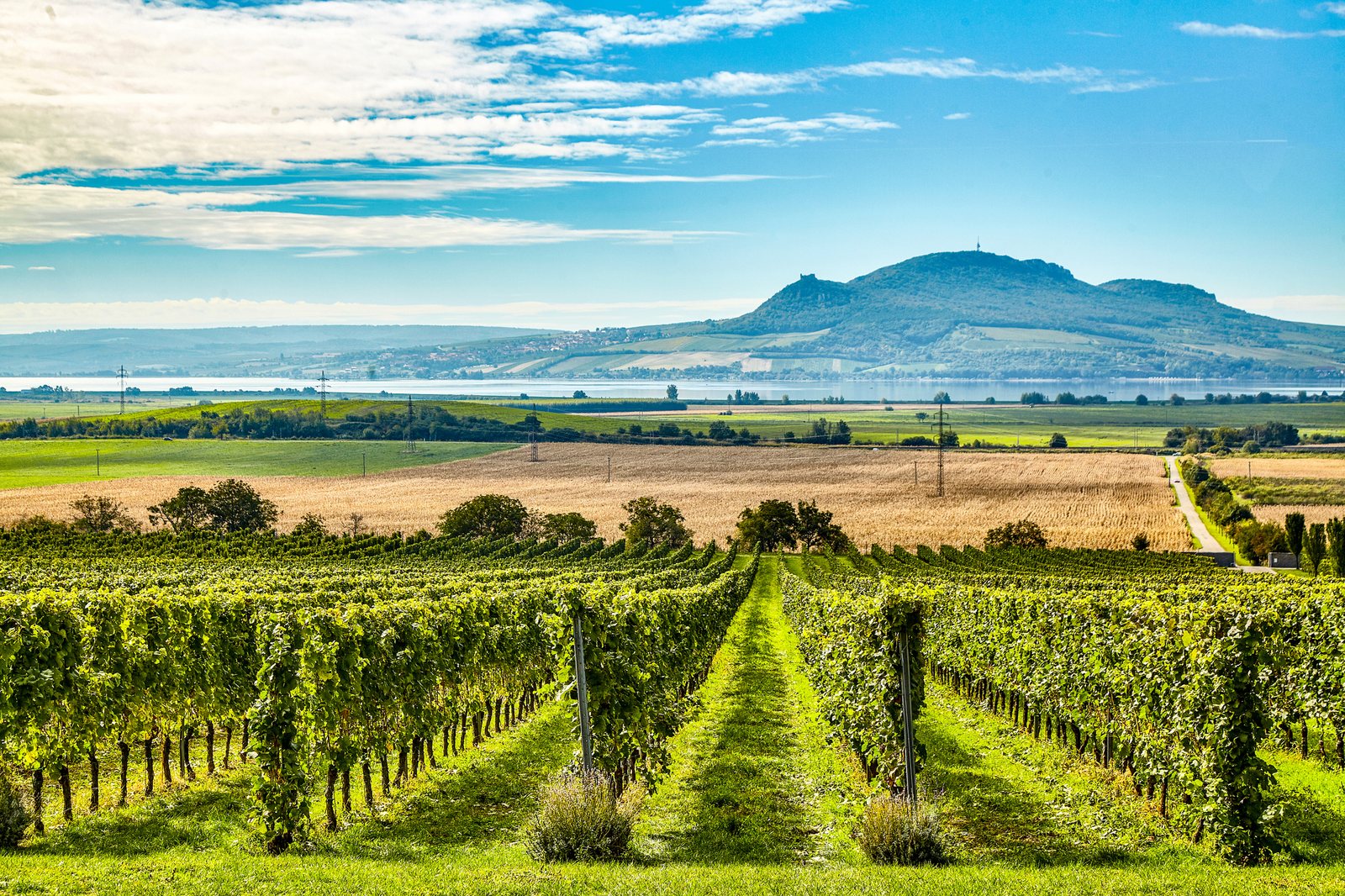
The undiscovered one. Ninety-six per cent of Czech vineyards are in Moravia, on the same latitude and much the same limestone as the Austrian Weinviertel a few kilometres south — and almost nobody in Britain has drunk any of it, because the Czechs drink nearly all of it themselves.
The base is Mikulov: a baroque town of pale render and red roofs beneath a castle on a limestone crag, with the Pálava hills standing over the vineyards like a set of broken teeth. It has a Holy Hill topped by a pilgrimage chapel, and a Jewish quarter and hillside cemetery that made it, until 1938, one of the most important Jewish towns in central Europe.
The riding is what makes it work. The Moravian Wine Trails are 1,250 kilometres of signed cycle routes threading vineyards, orchards and cellar lanes; the Mikulov circuit is 82km and can be cut to whatever length suits. Next door is the Lednice–Valtice Cultural Landscape, a UNESCO site and probably the largest designed landscape in Europe — 200 square kilometres of park laid out by the Liechtensteins with avenues, lakes, follies, a minaret and two châteaux, all of it flat and threaded with trails.
And it is cheap in a way nothing else on this list is. Vienna flights are competitive, the bus over the border costs about €10, and a bottle of good Riesling drunk in the cellar where it was made costs less than a pint in London.
A little history
Vines have grown here since the Roman Xth legion camped at Mušov, and the region has been fought over and repopulated ever since. Mikulov was the seat of the Dietrichstein princes and, for centuries, of the Moravian chief rabbinate — the Jewish community here was the largest in Moravia and among the most learned in Europe. Anabaptist Hutterites, expelled from the Tyrol, settled these villages in the sixteenth century and left behind the beautiful blue-and-white Habán pottery. Then the twentieth century: the German-speaking population that had farmed these vineyards for generations was expelled after 1945, breaking the continuity of the wine trade at a stroke; forty years of communist co-operative farming followed, chasing volume; and the border with Austria became the Iron Curtain, wired and patrolled, which is why the cycle route along it is called the Iron Curtain Trail. The revival since 1989 has been quick and is now producing wine that deserves to be exported — except that the Czechs keep drinking it.
What it costs
Per person for the whole weekend, priced for a party of four — two twin rooms, or one whole place between you. Everything but the bed is fixed, so where you sleep is the only row that moves and the only one shown as a range.
| Per person | |
|---|---|
| Getting there, both ways | £122 |
| Three nights | £45–110 |
| Bikes and getting about | £38 |
| Eating, drinking and tastings | £90 |
| The weekend, per person | ~£300–360 |
Where to sleep
| Option | Per person |
|---|---|
| Hotels — two twin rooms | |
| Pensions in Mikulov | 600 Kč a night £60 for three |
| Small hotels and wine-house rooms | 1,100 Kč a night £110 for three |
| Airbnb and self-catering — one whole place | |
| Entry-level flats in Mikulov | €17 a night £45 for three |
| The typical Mikulov listing | €25 a night £65 for three |
Rates peak in September, which is exactly when you would want to be here.
Eating and drinking
| What | Each |
|---|---|
| A polední menu — soup and a main | 180–250 Kč |
| Dinner at a mid-range restaurant with a drink | 400–700 Kč |
| A glass of house wine | 35–45 Kč |
| Two hours in a cellar tasting whatever you like | 599 Kč |
The £90 above assumes the middle of this list: a cheap lunch, an ordinary dinner, one good one over the weekend, and wine throughout. It does not change with the room.
Day by day
Friday Arrive & Mikulov
- Morning flight to Vienna, bus straight from the airport, in Mikulov by mid-afternoon.
- Walk the town: the château above the square, the arcaded houses, and the Jewish quarter — a synagogue, a mikveh and a hillside cemetery of some four thousand stones, the resting place of generations of Moravian chief rabbis.
- Climb the Svatý kopeček, the Holy Hill, at the end of the afternoon: a chapel and a line of baroque stations of the cross up a bare limestone ridge, with the whole vineyard plain and the Pálava crags laid out below.
- Dinner with a glass of Pálava — a grape crossed and named here, aromatic and off-dry, and grown almost nowhere else on earth.
Saturday Valtice, Lednice and the Liechtenstein park
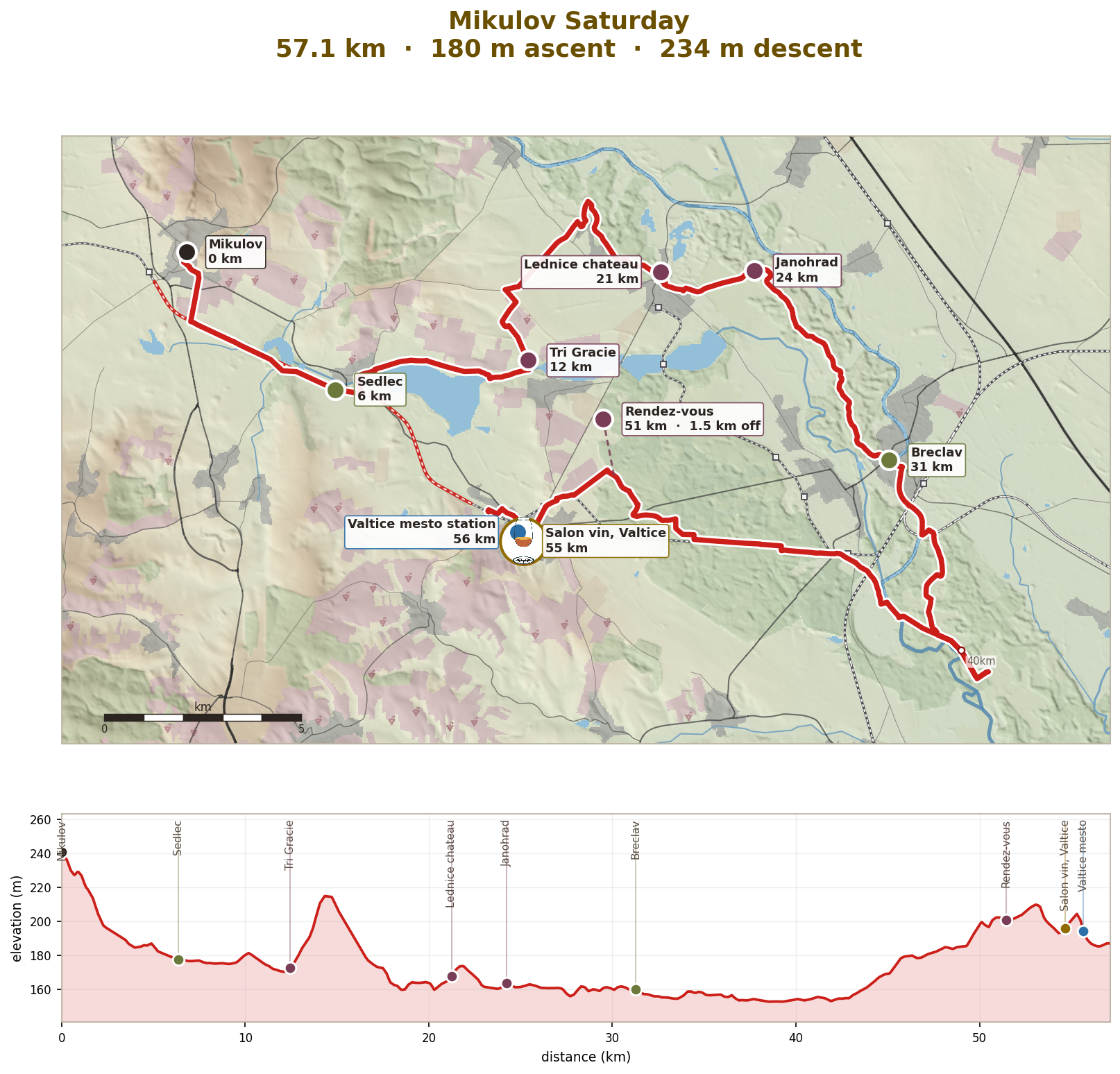
- 57.1km with 180m of ascent — flat, wooded and almost entirely on cycle routes through the UNESCO Lednice–Valtice landscape, an entire county laid out as a garden by one family over three centuries.
- East through Sedlec at 6km, then into the park past the Tři Grácie colonnade at 13km, standing alone in the trees.
- Lednice at 21km: a neo-Gothic fantasy château with a vast Victorian glasshouse, and out in the park a genuine minaret put up in the 1790s by a prince who wanted a folly and could afford a good one. Janohrad at 24km is a mock ruin, built as a ruin.
- South to Břeclav at 31km and back west through the woods, past the Rendez-vous — a triumphal arch that is actually a hunting lodge — at 51km.
- Valtice at 55km, and this is the point of riding it in this direction. Under the château is the Salon vín, the national wine salon: the hundred best Czech wines of the year, chosen by competition, laid out in the cellars for self-guided tasting. It is the most efficient way to understand Czech wine that exists, and it costs a fraction of the French equivalent.
- Then the train, not the bike. Valtice město station is a few hundred metres on, and line 246 runs back through Sedlec to Mikulov. Given the law here, that is not a convenience — it is the only way to do the Salon vín and get home.
57.1 km · 181 m of ascent · 153–241 m
Sunday The flat west first, the Pálava ridge as the finish
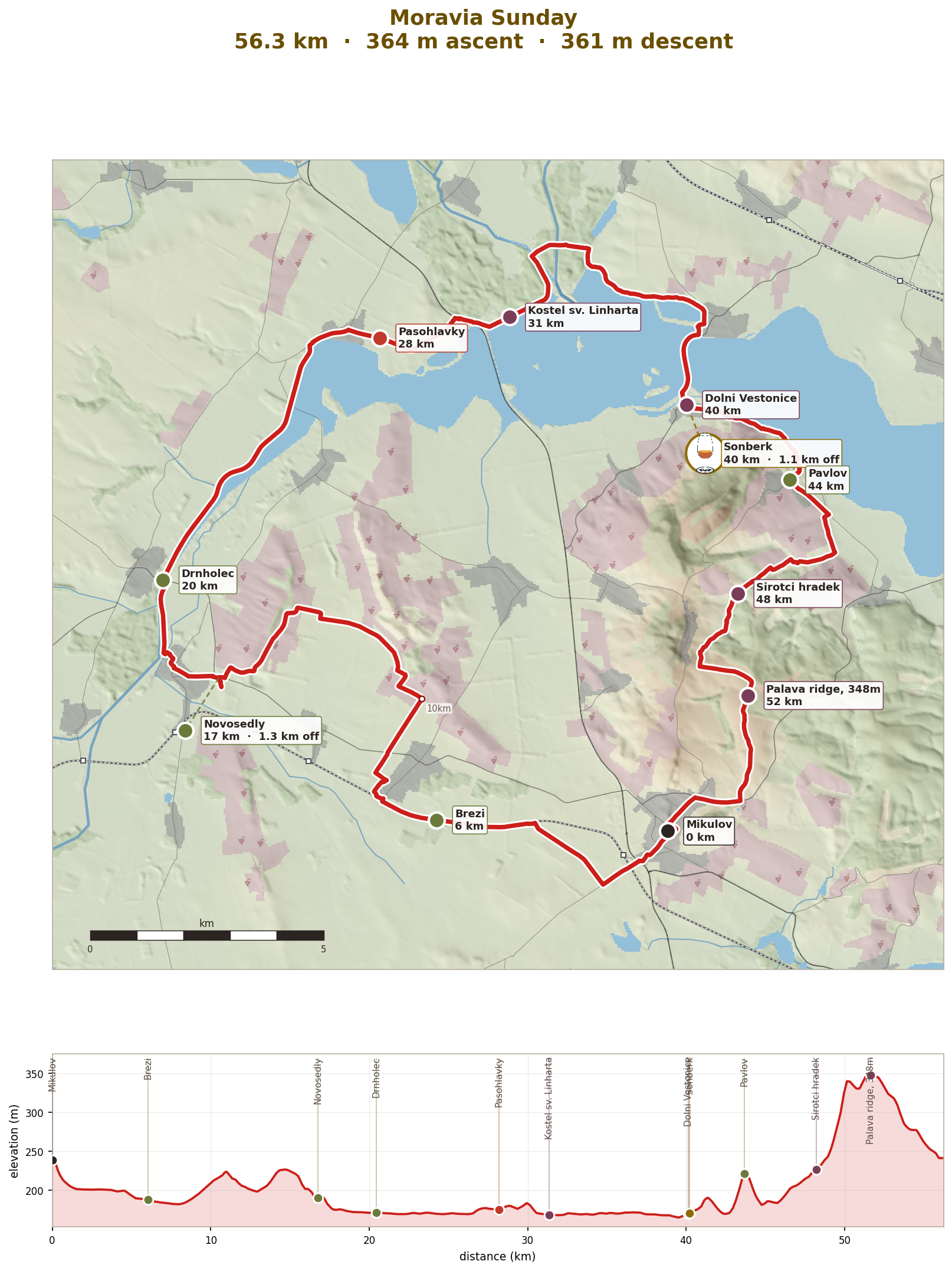
- 56.3km with 364m of ascent — and it takes in everything, but the other way round from the obvious direction: the flat west first, the Pálava ridge as the finish, and the tasting three-quarters of the way in.
- West out of Mikulov through Březí at 6km and Novosedly at 18km to Drnholec at 20km, on country almost nobody rides.
- Pasohlávky at 28km, on the Nové Mlýny reservoirs, for lunch.
- At 31km, the strangest stop of the weekend. The Romanesque church of St Linhart stands alone at the water’s edge — all that was left above the surface when the village of Mušov was drowned under the reservoirs in the 1970s. Beside it is the site of the northernmost Roman military installation in central Europe.
- Dolní Věstonice at 40km. The Venus came out of the ground here: fired clay, roughly 29,000 years old, the oldest known ceramic object anywhere — made before anyone had thought to fire a pot. The museum tells it properly. Děvičky castle stands on the ridge directly above.
- Sonberk at 41km, a kilometre off the line on the ridge above the lakes. Ridden this way the tasting falls where it should, with fifteen kilometres left rather than forty — but book ahead, and remember the drink-cycling rule below.
- Pavlov at 44km, one of the prettiest villages in the country, with a lane of whitewashed cellars cut straight into the slope.
- Then the ridge. Sirotčí hrádek at 48km — the Orphan’s Castle, a ruin on a crag; leave the bikes at the bottom, the last stretch is a scramble — and the Pálava ridge at 52km and 348m, bare limestone steppe with the whole plain below. The climbing is all in the last fifteen kilometres, and it is the right way to finish.
- Mikulov at 56km, downhill off the ridge.
56.3 km · 364 m of ascent · 165–348 m
Monday Home
- Slow morning in Mikulov: the square, the château cellars with their enormous 17th-century barrel, and a last look at the hills.
- Bus back to Vienna airport, about an hour and a half, and the evening flight home.
When to go
Spring — March to May
8–19°C, the Pálava hills green and full of orchids — the limestone steppe here is a botanical reserve, and spring is when it performs. Open cellar days start.
Summer — June to August
18–28°C, warm and continental, with long evenings in the cellar lanes and the Lednice park at its most lush. Thunderstorms build over the hills.
Autumn — September and October
9–18°C. Burčák on sale from August, the harvest festival in Mikulov in September, and the vineyards turning under the crags. Crisp, clear and cheap.
When to go
Second weekend of September for the Pálavské vinobraní, or May for the orchids and empty trails.
Festivals
None of this weekend assumes a festival. The rides work on any weekend of the season. If your dates land on Pálavské vinobraní on the second weekend of September, Mikulov is the event and the base is in the middle of it: ride early, be back by lunchtime, and do not expect a quiet town. The trade is worth stating plainly: on a festival weekend the growers are behind a stand in the square rather than showing visitors round a cellar, so book private tastings weeks ahead or accept that some will be shut, and expect beds to be scarcer, dearer and gone months in advance.
Spring
Open cellar days — spring weekends
Villages open their cellar lanes together and a single ticket walks you along the row.
Summer
Summer in the Lednice–Valtice park — June to August
Concerts and events in the châteaux and follies of the UNESCO landscape.
Autumn
Pálavské vinobraní, Mikulov — second weekend of September
The biggest event in the Czech wine calendar: a costumed royal procession, brass bands, hundreds of stalls and a great deal of burčák.
Svatomartinské víno — 11 November at 11:11am
The new vintage released across the country to the minute, and eaten with roast goose.
Getting there
From London, per person, assuming bikes are hired locally rather than flown. Fares checked September 2026 and converted at €1 to 86p.
| Leg | Time | Cost |
|---|---|---|
| The flight | ||
| Gatwick, Heathrow, Stansted or Luton to Vienna (VIE) — several a day, from around £45 one way | 2h 20 | £52 |
| Vienna to Mikulov | ||
| FlixBus from the airport door to Mikulov, from €10 — cheaper and simpler than anything else here. Buses also run from Wien Hauptbahnhof | 1h 35 | £9 |
| Waiting, and a border crossing that is invisible but still a border | 0h 45 | — |
| Door to door, one way | 4h 40 | £61 |
| Both ways | £122 | |
Czech koruna, not euros. Some cellars take cards; plenty of small ones do not.
Bike hire
Assumes hybrids.
| Shop | Rate |
|---|---|
| RentBike.cz, Mikulov and Brno — trekking and mountain bikes, and it will deliver for a flat 350 Kč however many bikes you take | 440 Kč a day 540 Kč mountain |
| Mikolovna, Mikulov — over a hundred bikes and e-bikes, with helmet, lock and phone holder thrown in | rates on request |
| CykloPomoc — fifty trekking bikes, open 8.30 to 18.30 daily | rates on request |
The cheapest bike hire on the site, by some way.
Getting about
| What | Cost |
|---|---|
| Bike hire, Saturday and Sunday | £30 |
| Regional trains and buses round the Pálava, allow | £8 |
| Getting about, whole weekend | £38 |
The wineries
Salon vín České republiky
The hundred best Czech wines of the year, chosen by competition, laid out in the château cellars for self-guided tasting. Nowhere else lets you cover the whole country in an afternoon, and the price would be unthinkable in France.
Sonberk
A modern winery on a ridge above the lakes, as good-looking a building as any on this list, making some of the country's best Riesling and Pálava. Book ahead; the terrace alone justifies the ride.
Vinařství Volařík
A family winery in Mikulov itself, which makes it the easy evening visit — Riesling and Veltlínské from the limestone slopes right above the town.
Reisten
Well-regarded whites from the steep sites beneath the crags, and a tasting room with the view up to the ruins.
The cellar lanes
Not one producer but rows of whitewashed cellars dug into the hillside, each belonging to a family. Some open to visitors, some only if you know someone; the tourist office knows which.
The wines
Aromatic whites, above all. Veltlínské zelené (Grüner Veltliner) is the everyday grape, Ryzlink rýnský (Riesling) and Ryzlink vlašský (Welschriesling) the serious ones, and Sauvignon is unexpectedly good. Look out for Pálava, a Traminer crossing bred here in 1953 and named after these hills — grapey, spicy and off-dry. Reds are lighter and northern: Frankovka (Blaufränkisch), Svatovavřinecké (St Laurent) and Modrý Portugal. And the sweet wines are a bargain: ice wine and straw wine are both legally defined categories here and cost a third of what the German equivalents do.
Eat & drink
| Friday | Mikulov square — utopenci, dark bread and a glass of Pálava |
| Saturday | Valtice, after the Salon — château cellars then lunch in town |
| Sunday | Pavlov, in a cellar lane under the crags |
| Monday | Last Moravian breakfast, then the bus |
The food
Proper cellar food, and no pretension anywhere. Utopenci — 'drowned men', sausages pickled with onion and chilli — and nakládaný hermelín, camembert marinated in oil and paprika, both eaten with dark bread. Then bramborák potato pancakes, svíčková with cream sauce and dumplings, roast duck with red cabbage, and Znojmo gherkins in everything. In the cellars the standard accompaniment is bread, lard and raw onion, which sounds worse than it eats.
Where to stay
Hotel Tanzberg
A small hotel in a restored house in the old Jewish quarter, with a kosher-influenced restaurant and the best position in town.
Hotel Galant
Larger and more comfortable, with a spa, a swimming pool and its own winery on site — useful if the group wants to swim after riding.
Pensions in Pavlov
Simple, cheap village rooms directly beneath the Pálava cliffs and the cellar lane. The prettiest option, and about half the price of the town hotels.
Practical
- Czechia is absolute zero — 0 g/l for cyclists exactly as for drivers, and enforced. Riding and tasting have to happen at different ends of the day. See the country-by-country table.
- Czech law is zero-tolerance for cyclists, not just drivers. There is no permitted blood-alcohol level on a bicycle, fines run into thousands of koruna, and the police do stop people. This is the one destination here where tasting and riding genuinely cannot be combined — so ride in the morning, park the bikes, and taste in the afternoon on foot. The cellar lanes at Pavlov and the Salon at Valtice both work perfectly well that way.
- It is the cheapest weekend on the list by a clear margin — flights to Vienna, a €10 bus, £12-a-day bike hire and cellar prices that will make everyone laugh.
- Bring koruna. The Czech Republic is not in the euro, and the smaller cellars are cash-only.
- Very little English in the villages. Mikulov and the château cellars are fine; a family cellar in Pavlov may not be. German is often more useful than English here.
- Book Sonberk and any small cellar ahead — this is not a region with a walk-in tasting-room culture outside the festival weekends.
- The bus is the whole transfer plan. Check the FlixBus timetable before fixing flight times; there are only a handful of services a day.
- Take the Pálava climb seriously or skip it — the ridge to Děvičky is the only real ascent of the weekend, and it is optional.
- Moravian Wine Trails — the 1,250km signed network, route by route
- South Moravia tourism — the regional board — trails, towns and the UNESCO landscape
- Salon vín ČR, Valtice — the national wine salon in the château cellars: what it is and how to visit
- Pálavské vinobraní — the September harvest festival in Mikulov, with dates and programme
- Wines from Czechia — the national wine board's event calendar in English