The weekend
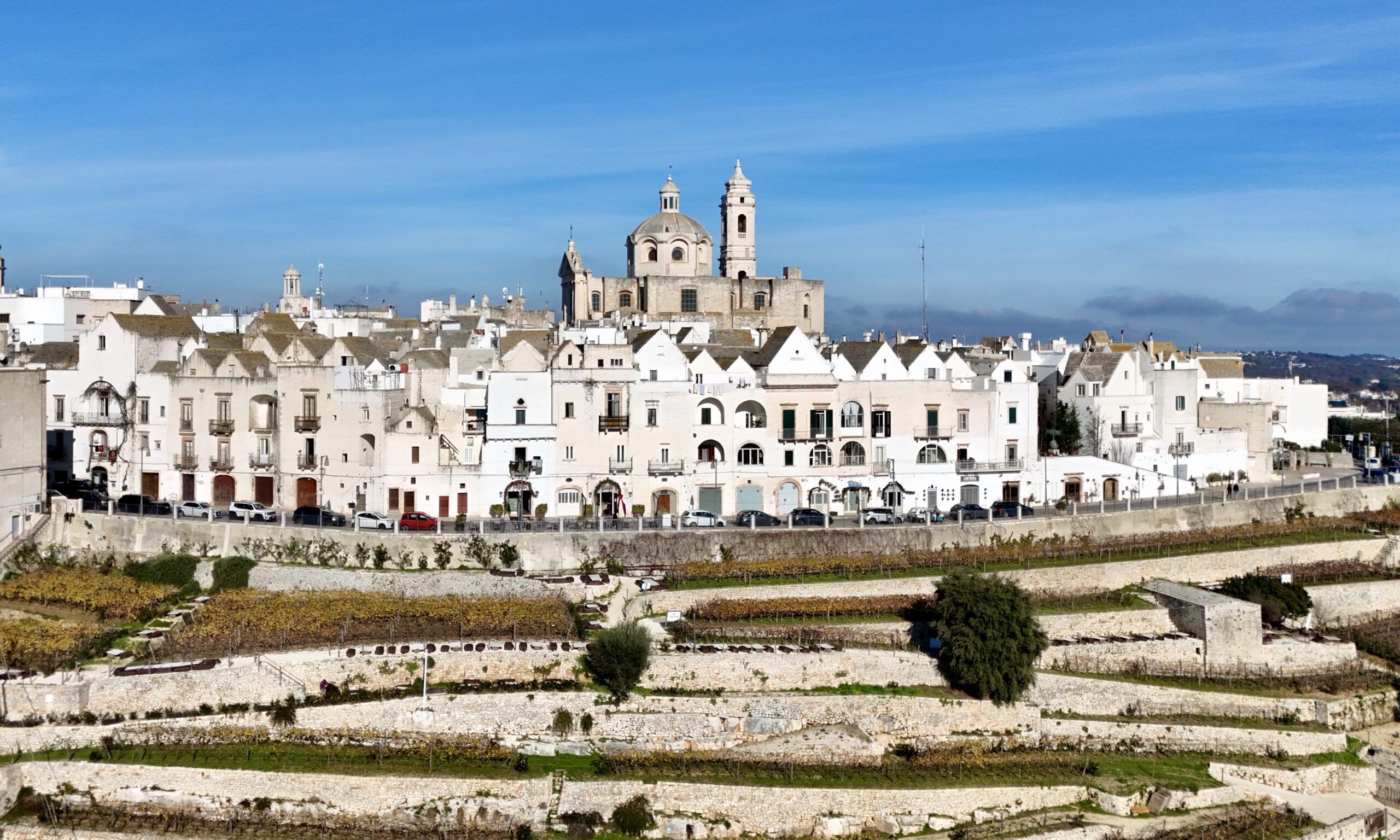
Four days on a limestone plateau four hundred metres above the Adriatic, based in Locorotondo — a white town laid out in concentric rings on a low hill, which is what the name means. Below it the Valle d'Itria is not really a valley at all but a shallow basin of dry-stone walls, olives, vines and several thousand trulli: conical drystone huts with no mortar in them, built that way so they could be pulled down when the tax inspector came.
The wine is the surprise. Everyone associates Puglia with Primitivo and Negroamaro, big and dark and warm. The Valle d'Itria makes neither — it makes white, from Verdeca and Bianco d'Alessano, on limestone at altitude, with firm acidity and a flinty edge. Locorotondo DOC and Martina Franca DOC are among the few white appellations in the south, and almost none of it leaves the province.
The riding is on empty white-stone lanes between the walls, and it has a spine: the Ciclovia dell'Acquedotto Pugliese, laid along the service walkways of the aqueduct that has carried water across Puglia since 1906. Unpaved, completely traffic-free, and the Saturday rides the whole of the Valle d'Itria section of it.
A little history
The trulli are mortarless because mortarless buildings were not, in the 17th century, taxable as dwellings — pull out the keystone and the cone collapses, and the count's tax return stays clean. Whatever the truth of that story, the technique is prehistoric and the surviving cones mostly date from the 1600s onwards. The aqueduct that now carries the cycle route was begun in 1906 to bring water from the Sele in Campania across the whole of Puglia, and it is the reason the region was habitable at scale at all.
What it costs
Per person for the whole weekend, priced for a party of four — two twin rooms, or one whole place between you. Everything but the bed is fixed, so where you sleep is the only row that moves and the only one shown as a range.
| Per person | |
|---|---|
| Getting there, both ways | £178 |
| Three nights | £65–115 |
| Bikes and getting about | £51 |
| Eating, drinking and tastings | £155 |
| The weekend, per person | ~£450–500 |
Where to sleep
| Option | Per person |
|---|---|
| Hotels — two twin rooms | |
| Trulli Caroli and others — a genuine trullo without the luxury price | €25 a night £65 for three |
| Converted trulli and small masserie | €46 a night £115 for three |
| Airbnb and self-catering — one whole place | |
| The typical Locorotondo listing — 564 of them, and a trullo of your own is the ordinary option here rather than the extravagant one | €29 a night £75 for three |
Eating and drinking
| What | Each |
|---|---|
| A fornello pronto at Cisternino — choose the meat at the butcher’s counter and they grill it | €15–25 |
| A trattoria dinner | €20–35 |
| Capocollo di Martina Franca, a Slow Food presidium | €5–10 |
| Tastings of Verdeca and Bianco d’Alessano | €10–20 |
The £155 above assumes the middle of this list: a cheap lunch, an ordinary dinner, one good one over the weekend, and wine throughout. It does not change with the room.
Day by day
Friday Arrive & the rings of Locorotondo
- Fly in the morning, transfer up onto the plateau, check in. Bikes can be delivered to the accommodation — Puglia On Bike and Nolè both hire gravel bikes and e-bikes in Locorotondo.
- Walk the centro storico before dinner. It is genuinely circular, whitewashed, and small enough to cross in ten minutes; the cummerse, steep gabled roofs found almost nowhere else in Puglia, are the thing to look up at.
- First tasting at the Cantina del Locorotondo, the co-operative in the town itself — 1,300 grower members and the engine of the appellation since 1932.
Saturday Train to Putignano, the trulli early, and the aqueduct home
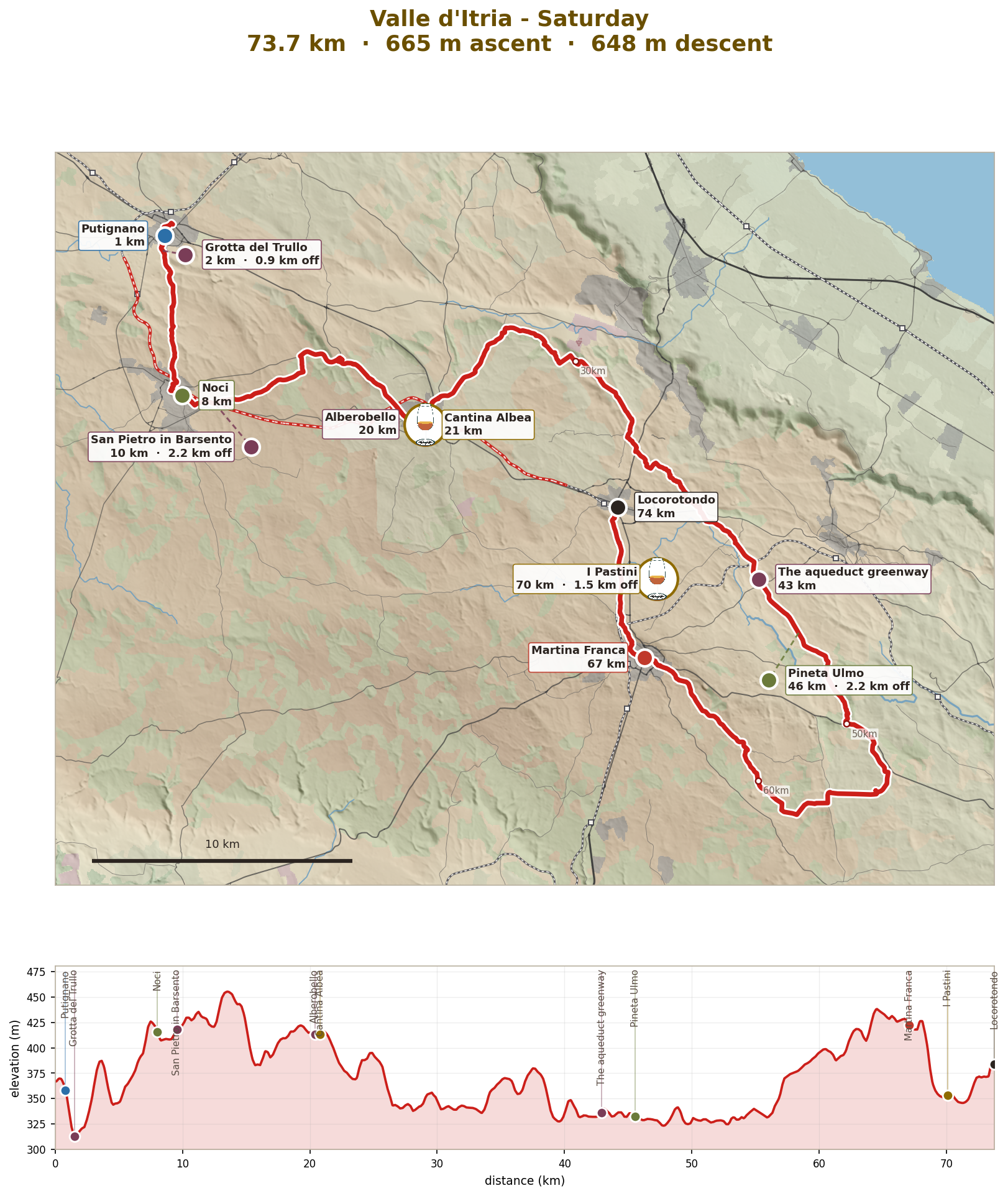
- 73.7km with 665m of ascent — one way, with the train doing the outward leg. It is a long day but not a hilly one: the whole route sits between 312 and 455m, so the climbing comes in short rises rather than anything sustained.
- The train first. Locorotondo to Putignano is about forty minutes up the line through Alberobello and Noci — eighteen trains a day, the first before five, so take an early one. Putignano is a warren of lanes rather than a town with a piazza, and its carnival, the oldest in Europe, is scattered through the old town as a museum in pieces. The Grotta del Trullo below it was the first show cave opened to the public in Puglia, found by accident in 1931 during sewer works — though it will not be open this early.
- Noci at 8km, after two rises of 75 and 82m to get up onto the plateau. The thing to find here are the gnostre — small enclosed courtyards off the lanes, which were streets until the town built around them. San Pietro in Barsento is a couple of kilometres off the road at 10km: a basilica founded in 591 on the order of Pope Gregory the Great, standing alone in the fields under a roof of chiancarelle.
- Alberobello at 20km, and the morning still young. Fifteen hundred trulli in two districts, UNESCO-listed, and the most photographed thing in Puglia — which is exactly why the train matters. On an early start you are there well before the coaches. Cantina Albea is four hundred metres on, a stone cellar with cisterns cut into the rock beneath it.
- Past the door at 36km. The route runs within two kilometres of Locorotondo between the trulli and the greenway, which makes a natural escape if the day has gone long or the weather has turned.
- The Ciclovia dell'Acquedotto Pugliese from 43km, and the reason the day is shaped this way. Fifteen kilometres on the aqueduct's own service track — unpaved, entirely car-free, running south through the trulli country past Pineta Ulmo. It is the whole published length of the Valle d'Itria section, so you ride all of it.
- Martina Franca at 67km, at 421m and the high point of the afternoon, after a 67m pull up off the greenway. Baroque rather than rustic, all wrought iron and pale stone, and the thing to eat is capocollo di Martina Franca — a Slow Food presidium, smoked over oak and myrtle. Late for lunch; plan it as an early dinner or carry something.
- I Pastini at 70km, a kilometre and a half off the road: the serious producer of the valley, with Verdeca, Bianco d'Alessano and Fiano Minutolo. Tours and tastings bookable online, and the one to arrange before you leave home. Then three kilometres home.
73.7 km · 665 m of ascent · 313–455 m
Sunday Down to the Adriatic and back up
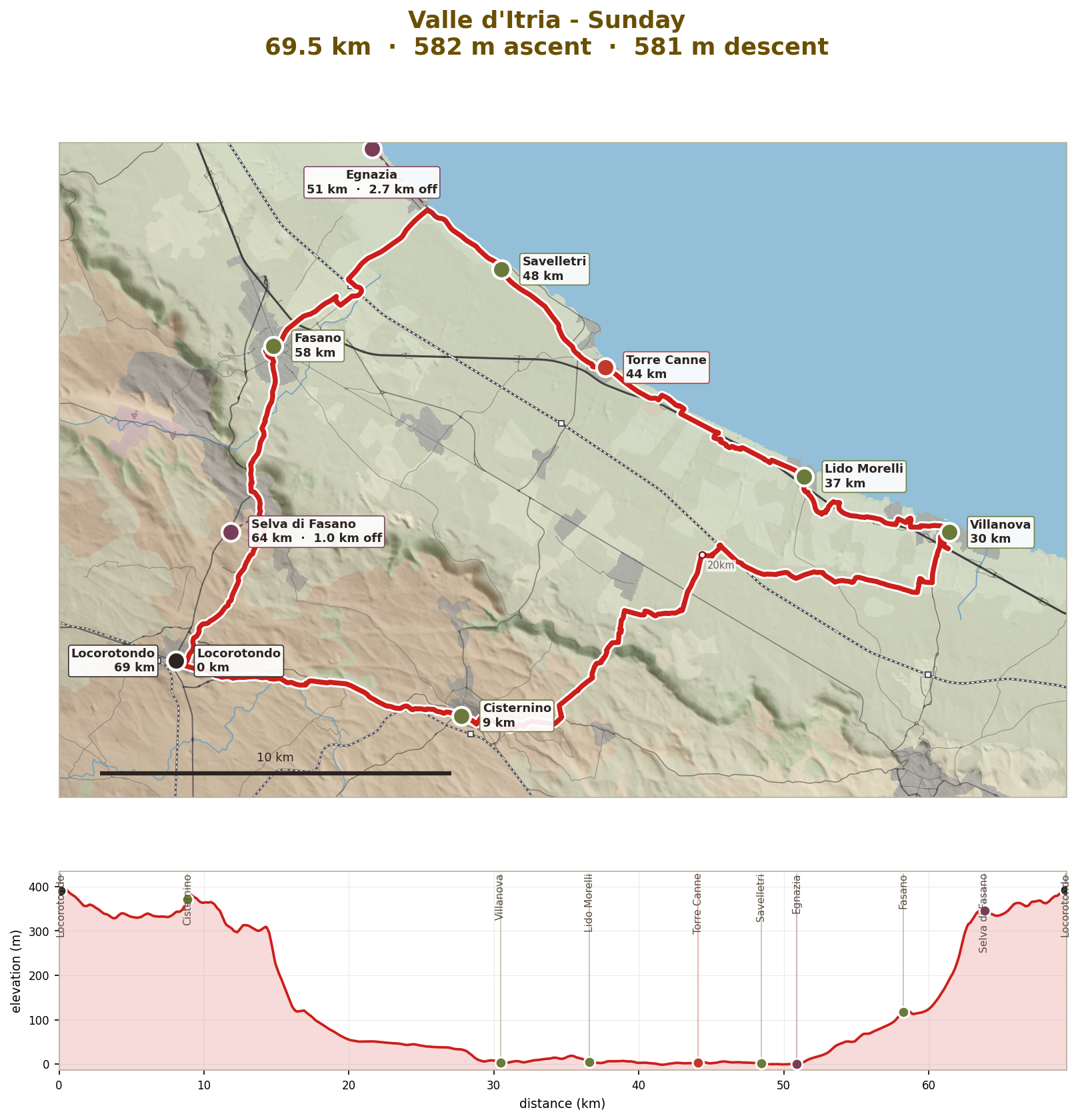
- 69.5km with 582m of ascent, and the profile tells the whole story: 390m at the door, sea level by 30km, twenty flat kilometres along the shore, then every metre of it back between 52 and 69km.
- Cisternino at 9km, on the lip of the escarpment with the whole plain and the sea below it. Then the drop — 370m to 50m between 14 and 20km — through olive groves where some of the trees are a thousand years old.
- The sea at 30km, at Villanova, and then twenty kilometres of flat shore road north-west through Lido Morelli to Torre Canne at 44km, which is lunch. Dune, pine and low limestone rather than a resort strand.
- Savelletri at 48km is a working fishing harbour with the best raw fish on the coast, and Egnazia is 2.7km further on: a Messapian and then Roman city standing on the shore, with its forum, basilicas and the Via Traiana running through it. Worth the detour and worth an hour.
- The climb back starts at Fasano, 58km in — 119m there, and 390m at home, almost all of it in the six kilometres up to Selva di Fasano, the hill village the Fasano gentry built to escape the summer. It is the hardest half-hour of the weekend and it comes at the end.
- Evening in Cisternino for the fornello pronto: you choose the meat at a butcher's counter, they grill it over wood, and it arrives at your table on paper. It costs almost nothing and it is the best meal of the weekend.
69.5 km · 583 m of ascent · -1–395 m
Monday Home
- Morning in Locorotondo — the Sunday market if the timing works — then the transfer back to Brindisi or Bari.
- Take the Verdeca home. Almost nobody in Britain stocks it, and you will not be able to buy it again.
When to go
Spring — April and May
12–23°C, wildflowers in the olive groves, and the best riding of the year. The sea is still cold in April and swimmable by late May.
Summer — June to August
22–33°C and rising. July and August on the Murgia are punishing — there is no shade on the plateau and the white stone throws the heat back at you. If you must come then, ride at dawn and swim at noon.
Autumn — September and October
14–27°C, harvest, and the sea still warm well into October. The other good window.
When to go
Late April to early June, or the second half of September into October. Those are the windows where the riding is comfortable and the sea is worth the descent. Avoid mid-July to late August unless the opera festival is the reason for the trip.
Festivals
None of this weekend assumes a festival. The rides work on any weekend of the season. If your dates land on San Rocco in mid-August, it is on the doorstep and the fireworks on the night of the 16th are the thing to stay up for — though that is also the hottest week of the year to be riding here. The Festival della Valle d’Itria at Martina Franca runs mid-July into August and the town is 8km away, so an evening performance costs you nothing but a taxi. The trade is worth stating plainly: on a festival weekend the growers are behind a stand in the square rather than showing visitors round a cellar, so book private tastings weeks ahead or accept that some will be shut, and expect beds to be scarcer, dearer and gone months in advance.
Spring
Festa di San Giorgio, Locorotondo — 22 and 23 April
The town's patron saint and the most significant day in its religious calendar. The dono, a solemn offering, on the evening of the 22nd; a market fair and processions through the old town on the 23rd.
Summer
Locus Festival — late July into August
An international music festival spread across the town and the surrounding countryside, from the main square to the woods, running from late afternoon into the night. Considerably better booked than a small hill town has any right to be.
Festival della Valle d'Itria, Martina Franca — mid-July to early August
A serious international opera festival in the courtyard of the Palazzo Ducale, in its fifties now, with a repertoire running from the eighteenth century to new commissions. Real quality — and the hottest weeks of the year for cycling, which is a trade worth thinking about.
Festa di San Rocco, Locorotondo — 15 to 17 August
San Rocco is credited with saving the town from plague in the 1690s and it has been repaying the debt ever since: three days of processions, music and illuminations, ending with a fireworks competition on the night of the 16th that draws people from all over the region.
Autumn and winter
Harvest and new oil — September to November
The grapes come in first and the olives follow. Neither is a festival exactly, but the frantoi press through the autumn and the new oil is worth going out of your way for.
Locus Winter — Christmas
The summer festival's cold-weather counterpart, in a transparent pavilion in Piazza Municipio.
Getting there
From London, per person, assuming bikes are hired locally rather than flown. Fares checked September 2026 and converted at €1 to 86p.
| Leg | Time | Cost |
|---|---|---|
| The flight | ||
| Ryanair, easyJet or BA to Brindisi (BDS) — 24 flights a week from London. Bari has 29 and more late departures, but is 25 minutes further out | 2h 50 | £70 |
| Airport to Locorotondo | ||
| Booked transfer or hire car, €90 for the vehicle. This is not a step-off-the-train destination — the local railway does not usefully connect the airports to the valley | 0h 50 | £19 |
| Waiting and finding the driver | 1h 00 | — |
| Door to door, one way | 4h 40 | £89 |
| Both ways | £178 | |
Bike hire
Assumes gravel bikes or fat tyres — the aqueduct track is unpaved, and it is the best part of the Saturday.
| Shop | Rate |
|---|---|
| Nolè Valle d’Itria, Locorotondo — bikes, e-bikes and accessories, and it runs airport transfers too, which solves two problems at once | rates on request |
| Apulia Bike Rental — delivers across Puglia, useful if you base outside Locorotondo | from €25 a day |
Getting about
| What | Cost |
|---|---|
| Gravel bike hire, Saturday and Sunday | £43 |
| Ferrovie del Sud Est trains for an evening out, allow | £8 |
| Getting about, whole weekend | £51 |
The FSE line is mid-rebuild and will not take an unbagged bike without a supplement, which is why both days are loops from the base.
The wineries
I Pastini
The serious producer of the valley and the one to arrange before you travel. Verdeca, Bianco d'Alessano and Fiano Minutolo across a proper range, with a tour of the vineyards and cellar and a tasting at the end. It sits on the Saturday route.
Cantina del Locorotondo
The co-operative, founded in 1932, with around 1,300 grower members. It makes the majority of the appellation and sells it at prices that will surprise you. The dependable option, and it is a two-minute walk from wherever you are staying.
Cantina Albea
An early 20th-century cellar built in stone with cisterns cut into the rock beneath it — as much industrial archaeology as winery. Whites from the valley alongside Primitivo brought up from the plain.
What you will not find here
Both are grown in Puglia but not on this plateau — Primitivo di Manduria and Gioia del Colle are an hour away by road, and Salento further. If big southern reds are the reason for the trip, this is the wrong corner of the region.
The wines
Verdeca and Bianco d'Alessano, blended, make Locorotondo DOC and Martina Franca DOC — Verdeca for acidity and structure, Bianco d'Alessano for body and a floral lift. Add Fiano Minutolo, an aromatic clone that smells of muscat and tastes dry, and you have the whole story. Grown at 400m on limestone, which is why they taste like nothing else in the south.
Eat & drink
| Friday | Dinner in Locorotondo — orecchiette and a bottle of the co-op's Verdeca |
| Saturday | Capocollo and bread in Martina Franca; dinner back in Locorotondo |
| Sunday | Lunch on the coast; fornello pronto in Cisternino in the evening |
| Monday | Coffee and a pasticciotto before the transfer |
The food
Orecchiette with turnip tops, bombette — rolled pork parcels stuffed with cheese and grilled — capocollo from Martina Franca, burrata from Andria, and the fornello pronto grills of Cisternino, where the butcher is also the kitchen. Bread from Altamura if you can get it.
Where to stay
In the centro storico, Locorotondo
Locorotondo has no large hotels — it has B&Bs and restored townhouses inside the ring, which is the right place to be. Both rides start and finish at the door.
A trullo in the countryside
Converted trulli and small masserie in the surrounding contrade, usually with a pool. Lovely, but check the last kilometre — some of the access tracks are rough, which matters at the end of a long day.
Martina Franca or Cisternino
Martina Franca is the biggest town and has the most rooms; Cisternino has the best grills. Both are on the route and both are on the local railway.
Practical
- Italy allows cyclists 0.5 g/l of blood alcohol, the same limit as drivers. See the country-by-country table.
- Hybrid or gravel, not road bikes. The contrade lanes are rough limestone in places, and the aqueduct greenway — if you add it — is unpaved throughout.
- The Saturday needs the train and the Sunday does not. Locorotondo to Putignano is about forty minutes on the Ferrovie del Sud Est line. FSE wants a separate ticket for a bicycle, one per passenger, and the size in their conditions is the bagged-bike envelope, so confirm before you rely on it — the line is also mid-reconstruction. If bikes are refused, ride the outward leg instead and drop the Barsento detour. The Sunday is a loop and needs no train at all.
- Budget for a transfer at both ends. Neither Bari nor Brindisi connects usefully to the valley by rail, and this is the only destination on the site where that is true.
- Book I Pastini before you leave home. It is the one arranged tasting of the weekend and it sits on the Saturday route; everything else here can be walked into.
- Go to Alberobello early or not at all. By late morning in season the trulli district is solid with coach parties. At nine it is almost empty.
- The Sunday is a descent followed by a climb, in that order, and there is no way of avoiding it — the base is at 390m and the sea is at nothing. The 390m comes back between 52 and 69km, most of it in the six kilometres above Fasano. E-bikes make it a different day.
- There is no shade on the plateau. Water, a hat and a sensible start time from June onwards; in July and August, ride at dawn.
- Check sunset before you plan the last leg. Any day that finishes with a ride home wants an hour of light in hand, and that hour disappears fast either side of the equinoxes.
- Ciclovia dell'Acquedotto Pugliese — the greenway, its route and which sections are open
- I Pastini — the valley's leading producer; tours and tastings
- Viaggiare in Puglia — the regional tourist board, with the trulli sites and local event listings
- The Trulli of Alberobello — UNESCO — the World Heritage listing and what it covers
- Festival della Valle d'Itria — the Martina Franca opera festival, programme and dates