The weekend
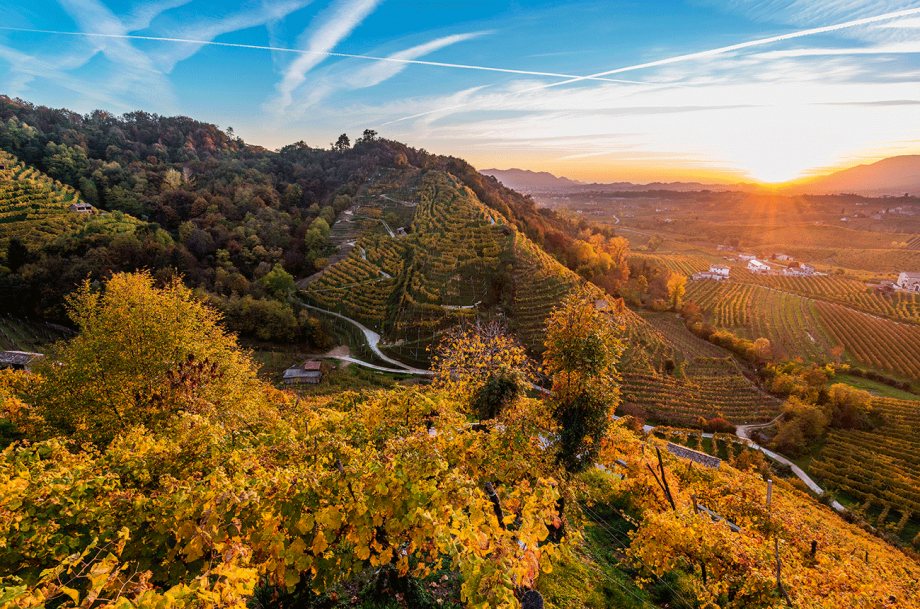
An hour north of Venice the plain suddenly crumples into a run of steep parallel ridges — rive — with vines planted straight up them. It is one of the strangest agricultural landscapes in Europe, and UNESCO listed it in 2019: slopes too steep for any machine, worked by hand, with the Dolomites showing behind on a clear day.
This fills the one real gap in the list. There is no sparkling wine anywhere else on it apart from Champagne and the cava of the Penedès, and Prosecco at source bears very little relation to the supermarket bottle. The wines to look for are Conegliano Valdobbiadene Prosecco Superiore DOCG, the single-hill rive bottlings, and Cartizze — 107 hectares on one hill, the most expensive farmland in Italy.
The catch is the gradient, and it is a real one. This is the hilliest option here by a distance: the Muro di Ca' del Poggio, the local climb everyone talks about, is 1.1km averaging 15% with a ramp of 19%. The riding sits between 100 and 400 metres, so nothing is long, but the climbs are sharp and they come one after another. E-bikes are not a nicety here, they are the plan.
And there is the Osteria senz'Oste — the 'inn without a host' — a stone hut among the vines above Santo Stefano, unlocked and unstaffed, where you cut your own cheese and salami, take a bottle, and leave money in a box. It is worth the climb on its own.
A little history
Conegliano has been arguing about wine since at least 1876, when Italy's first school of viticulture and oenology opened here — it trained most of the country's winemakers and still does. The painter Cima da Conegliano put these hills in the backgrounds of his altarpieces around 1500, and they are recognisably the same ridges. The 20th century arrived violently: the Piave, a few kilometres south, was the front line after the Italian collapse at Caporetto in 1917, and the final battle of the Italian campaign began at Vittorio Veneto — ten kilometres up the road — on 24 October 1918 and finished the war on this front within ten days. UNESCO inscribed the Conegliano–Valdobbiadene hills in 2019, citing the ciglioni grass terraces and the mosaic of vine, wood and small holding that hand-working has preserved.
What it costs
Per person for the whole weekend, priced for a party of four — two twin rooms, or one whole place between you. Everything but the bed is fixed, so where you sleep is the only row that moves and the only one shown as a range.
| Per person | |
|---|---|
| Getting there, both ways | £124 |
| Three nights | £80–100 |
| Bikes and getting about | £70 |
| Eating, drinking and tastings | £170 |
| The weekend, per person | ~£440–460 |
Where to sleep
| Option | Per person |
|---|---|
| Hotels — two twin rooms | |
| B&Bs around Valdobbiadene | €30 a night £80 for three |
| Agriturismo Prà dell’Ort and others in the hills — a farm stay with breakfast is the characteristic choice here | €38 a night £100 for three |
No published market data for Valdobbiadene. The agriturismi above are the self-catering-adjacent option and are priced in the hotel rows.
Eating and drinking
| What | Each |
|---|---|
| A trattoria dinner | €25–40 |
| Cicchetti and a glass, standing up | €8–15 |
| A glass of Superiore DOCG at the cellar door | €4–8 |
| Tastings on the Strada del Prosecco | €10–25 |
The £170 above assumes the middle of this list: a cheap lunch, an ordinary dinner, one good one over the weekend, and wine throughout. It does not change with the room.
Day by day
Friday Arrive & Valdobbiadene
- Afternoon arrival, car up into the hills, and the first sight of the ridges — which do not photograph as steeply as they are.
- Valdobbiadene is a working wine town rather than a pretty one; the pleasure is in the surroundings and the tasting rooms.
- First bottle: ask for a rive wine from a named hill, and taste it next to a basic Prosecco DOC from the plain. The difference settles the argument permanently.
Saturday The whole appellation in one day
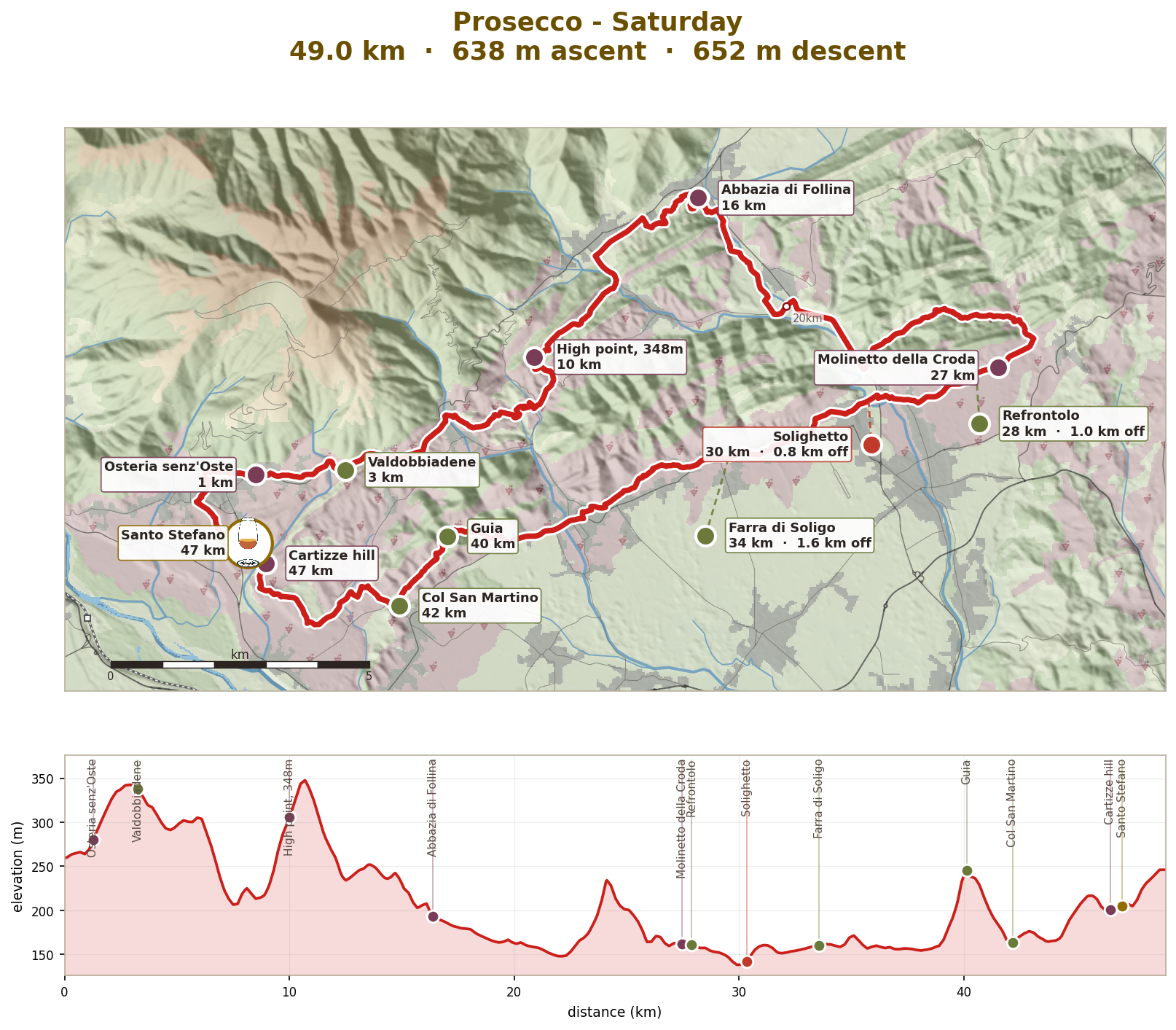
- 53.2km with 690m of ascent, a loop from Valdobbiadene, and the day the trip is built around. It takes in the two great sights of the region and finishes on the cru.
- East along the ridge road, climbing steadily to a high point of 348m at 10km with the Dentelles of the Veneto — the Prealpi — on one side and the plain dropping away on the other.
- Abbazia di Follina at 16km: Cistercian, twelfth century, and one of the loveliest quiet cloisters in the Veneto. Free, usually empty, and worth locking the bikes for.
- Molinetto della Croda at 32km, below Refrontolo — a seventeenth-century watermill built directly into a waterfall, which is exactly as good as it sounds. Refrontolo itself is the home of Refrontolo Passito, a sweet red made from dried Marzemino that almost nobody exports.
- Solighetto at 35km for lunch, then west along the foot of the hills through Farra di Soligo.
- Back up onto the ridge at Guia, 44km, down through Col San Martino at 46km, and over Cartizze itself at 51km — 108 hectares on a steep south-facing pitch, and the most expensive vineyard land in Italy.
- The tastings are at 51km, two kilometres from the finish. Col Vetoraz and Bisol 1542 are both at Santo Stefano, high on the Cartizze slope with a terrace over the valley. Then the Osteria senz'Oste above them: no staff, no bar, an honesty box in an unlocked hut among the vines, and the view down the whole run of ridges. Bring cash.
49.0 km · 639 m of ascent · 138–347 m
Sunday Down to the plain, the battlefields, and back up at the end
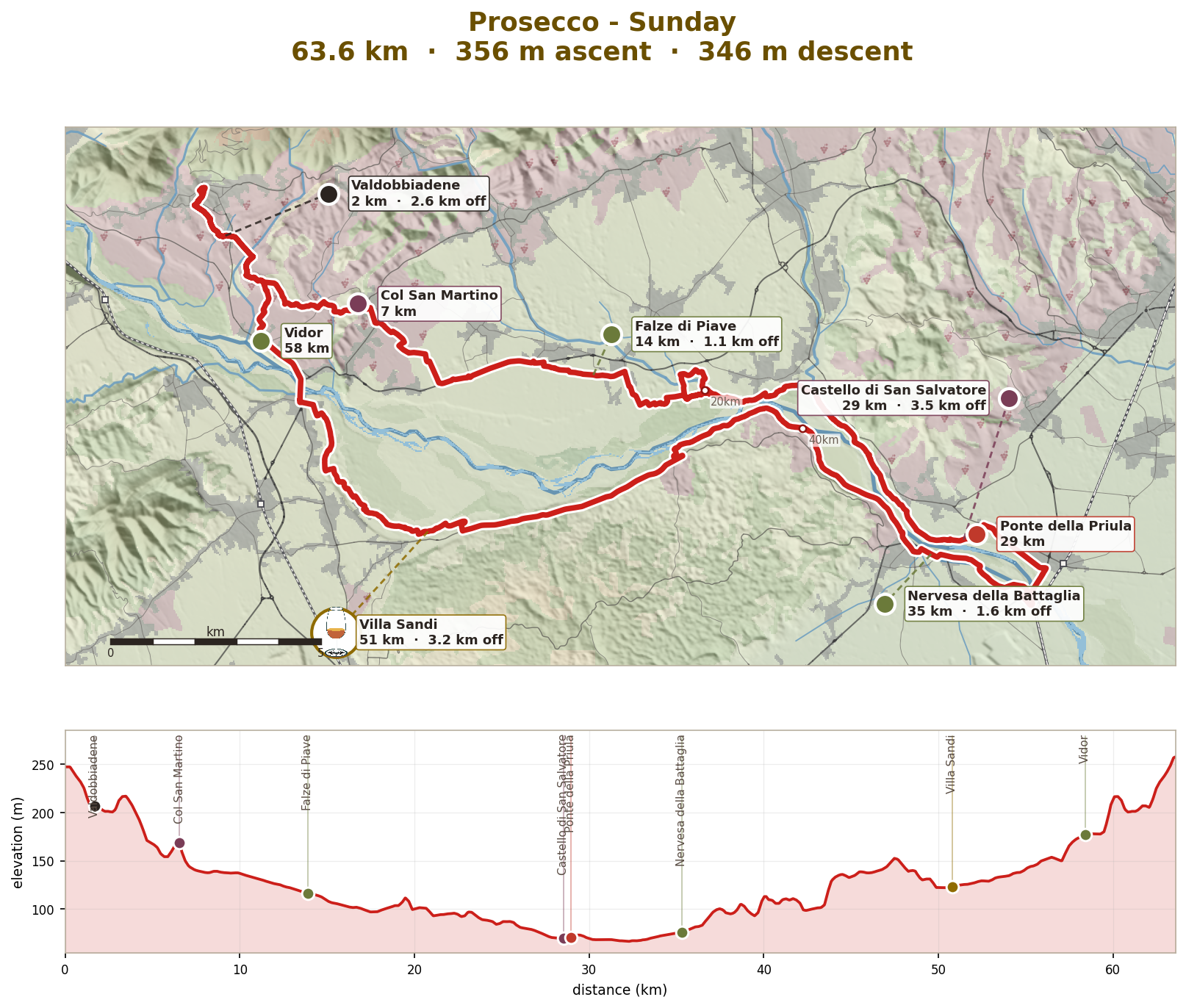
- 63.6km with 356m of ascent — longer than the Saturday and less than half the climbing, because it drops off the ridge in the first few kilometres and stays down. Ridden clockwise so the plain comes first and the hills at the end.
- Col San Martino at 7km, the last of the ridge, then down onto the flat.
- Falzè di Piave at 15km and east along the river. This is the high-volume side of the region — Prosecco DOC rather than Superiore, and worth riding precisely because it shows you the difference. What grows on a 40% slope and what grows on a floodplain are not the same drink.
- Ponte della Priula at 29km, on the river, for lunch. Castello di San Salvatore sits three kilometres off the line above Susegana: 250 hectares of vineyard, wood and olive grove around a medieval village and one of the largest castles in the Veneto, still the Collalto family’s. Cellar visits need a minimum of twenty people, so for a party of two or four this is a look from the road rather than a tasting.
- Nervesa della Battaglia at 36km, under the wooded hump of the Montello. This whole stretch of river was the front line in 1918, and the memorials, ossuaries and trench remains are everywhere once you start noticing them.
- Villa Sandi at 52km, just under 3km off the line at Crocetta del Montello — a Palladian villa of 1622 with two kilometres of cellars underneath. Still a detour, but a detour near the end of the day rather than the start. Mon–Sat 9.30–13.00 and 14.00–19.30.
- Vidor at 59km, back off the plain with the Abbazia di Santa Bona on the way past, and the last few kilometres up into Valdobbiadene.
63.6 km · 356 m of ascent · 67–257 m
All the wine is on the Saturday
That is deliberate, and worth knowing when you book. The Saturday runs the length of the DOCG and ends on the Cartizze slope with two cellars and the honesty-box osteria in the last two kilometres. The Sunday leaves the Superiore zone at Vidor and does not come back into it until Col San Martino at 57km — it is a landscape and history day, not a tasting day, and it is flat enough to ride with a hangover.
If you would rather have wine on both days, the fix is to shorten the Sunday: turn for home at Falzè di Piave instead of continuing to Nervesa, which cuts 25km and leaves an afternoon for the Valdobbiadene cellars. Nino Franco is in the town itself — the house that has argued hardest that Prosecco can be a wine for the table rather than an aperitif, and the place to ask for a single-vineyard or later-disgorged bottling.
Monday Conegliano, then home
- Down to Conegliano: the castle on the hill, Cima da Conegliano's altarpiece in the cathedral, and Italy's first wine school, founded in 1876 and still the most important in the country.
- Lunch, then the short run to Treviso — itself worth an hour if the flight is late, with canals, frescoed arcades and the restaurant that invented tiramisù.
When to go
Spring — March to May
8–20°C, the ridges greening and the cherry and apple blossom out. Vino in Villa fills the castle at San Salvatore in May. Rain is common; the hills are slippery.
Summer — June to August
18–29°C, warm and humid, with thunderstorms building over the Dolomites in the afternoons. The gran fondo in July is the local cycling event of the year, though it is a serious ride.
Autumn — September and October
10–20°C, harvest through September on slopes too steep for machines, and the ridges turning. Mist in the valleys in the mornings, and the Dolomites appearing after a front goes through.
When to go
May or late September. Both give the ridges at their best without high-summer humidity — and the climbs are hard enough without heat.
Festivals
None of this weekend assumes a festival. The rides work on any weekend of the season. If your dates land on the village mostre in September or October, they are strung along the route itself — pick the one nearest the day’s finish and end there. Avoid the Prosecco Cycling weekend in July unless you are riding it: the roads are closed and the beds are taken. The trade is worth stating plainly: on a festival weekend the growers are behind a stand in the square rather than showing visitors round a cellar, so book private tastings weeks ahead or accept that some will be shut, and expect beds to be scarcer, dearer and gone months in advance.
Spring
Vino in Villa — May
The appellation's annual showcase in the castle at San Salvatore, with the growers of the whole DOCG pouring together.
Mostra dello Spumante, Valdobbiadene — spring
The town's own sparkling wine show, smaller and more local.
Summer
Prosecco Cycling — July
A gran fondo through these hills, including the Muro di Ca' del Poggio. Not a gentle day out, but the roads are closed and the atmosphere is remarkable.
Autumn
Village wine shows and the 100 Miglia — September and October
San Pietro di Barbozza, Col San Martino and Santo Stefano each hold their own mostra, and classic cars run the Prosecco road in October.
Getting there
From London, per person, assuming bikes are hired locally rather than flown. Fares checked September 2026 and converted at €1 to 86p.
| Leg | Time | Cost |
|---|---|---|
| The flight | ||
| Ryanair, Stansted to Treviso (TSF) — 30km out and the closest airport. Venice Marco Polo has far more flights and is 50km away | 2h 00 | £45 |
| Into the hills | ||
| Pre-booked car to Valdobbiadene, €80 for the vehicle. Conegliano is easier by public transport — bus to Treviso Centrale, then 25 minutes on the Venice–Udine line | 0h 45 | £17 |
| Waiting and finding the driver | 0h 45 | — |
| Door to door, one way | 3h 30 | £62 |
| Both ways | £124 | |
Bike hire
Assumes e-bikes — the Strada del Prosecco is a switchback, and this is the one destination where nothing else really works.
| Shop | Rate |
|---|---|
| Italy Cycling Tour, Via Salton 21, Follina — road, mountain, gravel and electric, delivered to Conegliano, Valdobbiadene, Pieve di Soligo or Vittorio Veneto | rates on request |
| Italy Rent Vespa e Bike, Follina — electric only, with helmet, pump, lock and map | rates on request |
| Bike Point at Fasol Menin, Valdobbiadene — hire from the cellar door itself | rates on request |
Follina sits between the two towns, which is why the hire is concentrated there rather than in either.
Getting about
| What | Cost |
|---|---|
| E-bike hire, Saturday and Sunday | £60 |
| Trains on the Venice–Udine line, allow | £10 |
| Getting about, whole weekend | £70 |
The wineries
Conte Collalto
Two hundred and fifty hectares of vineyard, wood and olive grove wrapped round a medieval village and one of the largest castles in the Veneto, still in Collalto hands. They bottle only fruit from these vineyards. Cellar visits run to a minimum of twenty people, so unless you are a large party this is a ride-past rather than a tasting — worth checking whether your dates coincide with one of the castle's open weekends.
Col Vetoraz
Perched near the top of the cru with a terrace looking down the whole valley, and among the most consistent producers in the appellation. Tastings are straightforward to arrange.
Nino Franco
Long-established, and the house that has argued hardest that Prosecco can be a wine for the table rather than an aperitif. The single-vineyard and later-disgorged bottlings are the ones to ask for.
Bisol 1542
A family documented in these hills since the 16th century, with holdings in the heart of the Cartizze. Well set up for visitors.
Silvano Follador
Tiny production, no dosage, no compromise — the natural-wine end of the appellation, and a complete contrast to the big houses. Write ahead.
Osteria senz'Oste
Not a winery, but the stop everyone remembers: an unlocked hut among the vines where you cut your own cheese and salami, help yourself to a bottle, and leave the money in a tin.
The wines
Glera is the grape. The hierarchy matters more than usual: Prosecco DOC comes from the flat land across a huge area of the Veneto and Friuli; Conegliano Valdobbiadene Prosecco Superiore DOCG comes only from these hills; rive bottlings name a single steep hillside, of which there are 43; and Cartizze is the 107-hectare cru. Learn the sweetness ladder too, because it is counter-intuitive — brut is drier than extra dry, which is drier than dry. And ask for col fondo: the old cloudy style, refermented in the bottle and left on its lees, which tastes nothing like the export version and is what the growers drink at lunch.
Eat & drink
| Friday | First bottle in Valdobbiadene, next to a plate of sopressa |
| Saturday | Osteria senz'Oste — cut your own lunch, pay the box |
| Sunday | Follina, beside the abbey |
| Monday | Conegliano, or tiramisù in Treviso before the flight |
The food
Sopressa salami, hard Piave cheese and soft casatella, white asparagus in spring and radicchio in late autumn, spiedo — mixed meats turned on a spit for hours — and polenta with everything. Tiramisù was invented down the road in Treviso in the 1970s and the town takes the claim seriously. Everything here is designed to be eaten with a glass of something fizzy and dry.
Where to stay
Hotel Villa Abbazia
A restored 17th-century villa next to the abbey, family-run and full of character. The most charming base in the hills, and central for both days' riding.
Agriturismo on the Cartizze slopes
Rooms on working estates among the vines, often with the family's own wine at breakfast. Cheap, beautiful, and a climb home every evening.
Conegliano town hotels
Plainer, but on the railway and much the easiest to reach — the sensible choice if the group would rather not depend on taxis.
Practical
- Italy allows cyclists 0.5 g/l of blood alcohol, the same limit as drivers. Ask for a spittoon; every serious cellar has one. See the country-by-country table.
- E-bikes, without exception. The Muro di Ca' del Poggio averages 15% over more than a kilometre and touches 19%. The distances are short but the climbing is relentless, and this is the one destination here where an unassisted beginner would have a miserable time.
- Base decides the weekend. Valdobbiadene puts you among the best vineyards but ties you to taxis; Conegliano is on the railway and much easier, at the cost of a longer ride to the good hills.
- Book the Cartizze producers ahead. The big names take visitors readily, the small ones only by arrangement, and Sunday afternoons are quiet everywhere.
- Rain is a genuine possibility. October in the Veneto is not October in Roussillon — pack a shell, and have the Conegliano museums and Treviso as the wet-day plan.
- Ask for col fondo. Cloudy, bottle-fermented and bone dry; it is what the growers drink and it is almost impossible to find at home.
- Treviso airport is small and Ryanair-only. Venice Marco Polo has far more choice and is only twenty minutes further away — price both.
- If the trip lands on the 100 Miglia weekend in October, expect classic cars on the Prosecco road and book restaurants well in advance.
- Visit Prosecco Hills — the official destination site, with graded cycling routes and e-bike guidance
- Conegliano Valdobbiadene Prosecco Superiore — the consortium — the DOCG, the rive, and Cartizze explained
- UNESCO — Le Colline del Prosecco — the World Heritage inscription and why the landscape qualifies
- Strada del Prosecco — the wine road itself, with member cellars and opening hours
- Osteria senz'Oste — the hut in the vines, and how the honesty box works